

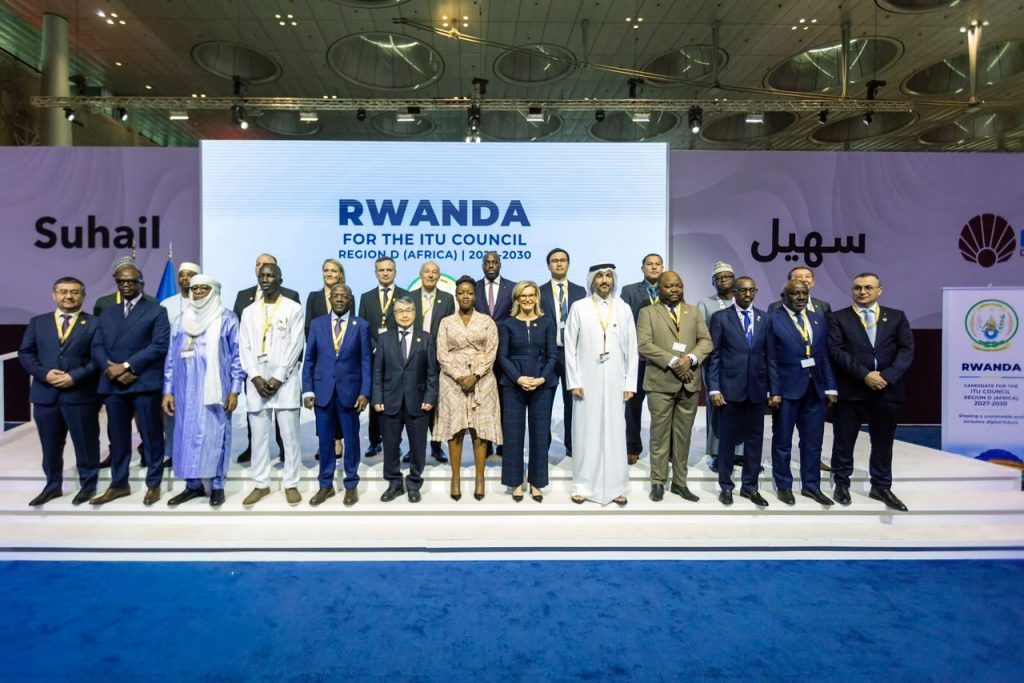
Rwanda has been re-elected to the Council of the International Telecommunication Union (ITU) for another four-year term, securing 127 votes in elections held during the agency’s 2026 Plenipotentiary Conference (PP-26).
The election, held on Monday, November 16, in Doha, gives Rwanda one of the 13 seats allocated to Africa on the 48-member Council for the 2027–2030 term.
Rwanda was elected alongside Algeria, Côte d’Ivoire, Egypt, Ghana, Kenya, Mauritius, Morocco, Nigeria, Senegal, South Africa, Tanzania and Tunisia. Kenya received the highest number of votes among African countries, with 136, followed by Côte d’Ivoire with 135 and Senegal with 134.
The Council oversees the ITU’s activities, policies and strategies between Plenipotentiary Conferences, helping guide the organisation’s work on global telecommunications and digital development.
Rwanda’s re-election maintains its participation in decisions shaping international telecommunications policy, including issues related to connectivity, digital infrastructure and the use of radio-frequency spectrum.
ITU leadership elections
During the same conference, member states re-elected Doreen Bogdan-Martin of the United States as ITU Secretary-General for a second term. She received 164 votes out of 173 cast.
Adel Darwish of Bahrain was elected Deputy Secretary-General after securing 90 votes in the final round of voting.
Other African representation
Africa also secured three seats on the ITU’s 12-member Radio Regulations Board (RRB), with Edmund Yirenkyi Fianko of Ghana, Basebi Mosinyi of Botswana and Sana Zairi of Morocco elected.
The board oversees the application of international rules governing radio communications, including the use of radio-frequency spectrum and satellite orbits.
About the ITU Council
Established in 1865, the ITU is a United Nations specialised agency responsible for coordinating global telecommunications and digital technologies. Its work includes managing international radio-frequency spectrum and satellite-orbit resources, developing telecommunications standards and supporting efforts to expand digital connectivity.
The Council comprises 48 member states elected every four years. Africa, Asia and Australasia each hold 13 seats, while the Americas have nine and Western Europe eight. Eastern Europe and Northern Asia have five seats.
The ITU’s Plenipotentiary Conference is its highest decision-making body, bringing together member states every four years to determine the organisation’s strategic and financial direction.

