On 4 September, the United Nations General Assembly voted 164 to 1 to encourage governments, schools, international organisations and technology companies to use equal-area world maps. The resolution was led by Togo on behalf of the African Group and built on an African Union campaign.
The news reached me in Nairobi, in the middle of preparations for the Trust Summit, surrounded by colleagues working on the question of why the world finds it so hard to trust Africa, and why Africa finds it hard to trust the world. My first reaction was not triumph. It was recognition. Something every African child has sensed while looking at a classroom wall had finally been named in the world’s most representative forum.
The Mercator projection was drawn in 1569 to help European sailors navigate. It was never meant to show the true size of countries, but for more than four hundred years it has been used as if it did. Greenland looks roughly as large as Africa, yet Africa is about fourteen times bigger. Europe and North America are inflated, and the equatorial world is shrunk. Generations of students, diplomats, investors and journalists have learned the shape of the world from a picture that made Africa look small.
Togo’s Foreign Minister, Robert Dussey, put it well: “A fair map does not change the geography of the world; it changes how we see the world.” The map did not create prejudice against Africa and people of African descent. It reflected that prejudice, and then it taught it to every generation that came after. The people who drew and kept this picture of the world did not see Africa as the centre of anything. The distortion survived because it suited the worldview of those who held the pen.
Narrative matters. Presentation of facts matters. Showing Africa at its true size pushes back against a bias that goes very deep.
The map is only the most visible distortion
The same inherited distortion shows up in the systems that decide Africa’s future.
It shows up in the cost of money. At the General Assembly this week, President William Ruto said plainly: “Africa does not lack resources. What Africa lacks is a fair system — one that does not price us out of the capital we need to develop.” African countries routinely pay higher risk premiums than comparable economies elsewhere. The UNDP estimates that fairer, less subjective credit ratings could save the continent tens of billions of dollars. That extra cost comes from a skewed picture of Africa, not from how its economies actually perform.
It shows up in how peace and security are governed. Africa has 54 nations and more than 1.4 billion people, and it is still the only continent without a permanent seat on the Security Council. President Ruto warned that “institutions that do not reflect the people whose cooperation they require will eventually struggle to command their trust.”
In the same week, President Alexander Stubb of Finland called for “at least two new permanent seats for Africa” and argued that “no single state should have veto power.” When a European head of state says this from the same podium, it shows that the case for correction is no longer only Africa’s to make.
I have spent much of my career pushing back against these assumptions from inside African institutions.
At the LéO Africa Institute, we set out to build a network of Africa champions. These are young leaders from across the continent who choose to invest their talent, ideas and ambition in Africa rather than measure themselves against somewhere else.
The programmes are built around agaciro, a Kinyarwanda idea of self-worth and dignity. In the early days, some partners assumed that serious leadership development had to be imported and certified elsewhere before anyone would take it seriously. Our fellows have proved otherwise. They now lead in business, government, civil society and the creative industries, and they show that Africa can grow leaders of global calibre by its own standards.
At Makerere University, one of the most consequential institutions of higher learning on the continent, I worked to help it become a next-generation university. That meant a research-led, globally connected institution that attracts investment on its own merits.
More than once, I sat across from partners who admired Makerere’s history but doubted its future, and who wondered whether an African university could steward major investment and deliver to world-class standards. The answer had to be shown, not just stated: in governance, in transparency and in results. Each time we delivered, the assumption lost ground. Correcting a distorted picture of Africa is rarely a single dramatic vote.
Most of the time it is slow work, done one institution and one partnership at a time.
Five things the world must learn to see at true scale
At the Trust Summit, we speak of restoring trust in African agency, dignity, systems, delivery and identity. The map vote shows what each of these means in practice.
- Agency is respected when Africa writes the resolution, as it did here, instead of waiting to be written about. It is denied when solutions for Africa are designed in rooms where Africans are guests.
- Dignity is respected when Africans are described accurately, at their true size and in their full complexity. It is denied when the continent is reduced to a single story of crisis and need.
- Systems are respected when African institutions such as courts, central banks, universities and regulators are trusted to do their work. They are denied when every African process is assumed to need outside supervision.
- Delivery is respected when Africa is judged on what it has achieved, from mobile money to vaccine logistics to peacekeeping. It is denied when success on the continent is treated as the exception and failure as the rule.
- Identity is respected when Africa defines itself on its own terms, including its diaspora and people of African descent everywhere. It is denied when the continent is known mainly through someone else’s projection, in every sense of the word.
What the Trust Summit will do with this moment
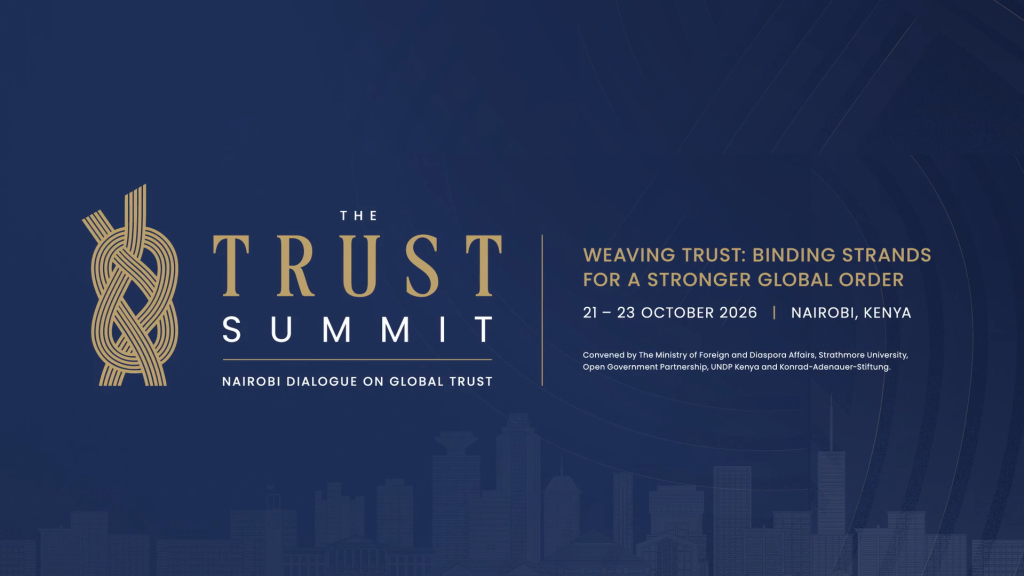
On 21–23 October, Kenya will host The Trust Summit: Nairobi Dialogue on Global Trust, under the theme Weaving Trust: Binding Strands for a Stronger Global Order. Trust depends on accuracy. No one can trust a system that misrepresents them, and no system can earn the trust of people it refuses to see clearly.
We intend to take the spirit of this vote into the Summit’s main outcome, the Nairobi Call to Action on Global Trust. We will propose a working principle for it: correct the record. Institutions that want Africa’s trust should be ready to review the inherited assumptions built into their rating models, their governance structures, their data and their stories, and to change them.
There are already examples to follow. The Correct the Map campaign was started by two African organisations, Africa No Filter and Speak Up Africa. The African Union adopted it, and the African Group carried it to the General Assembly, turning a long-standing complaint into a winning resolution. Global institutions have also begun to adjust.
The G20 made the African Union a permanent member in 2023, and the IMF added a third seat for sub-Saharan Africa to its Executive Board in 2024. Some European states have begun returning looted heritage, such as Germany’s return of the Benin Bronzes to Nigeria.
Leaders like President Stubb have argued for reforms that would reduce their own countries’ relative influence. Africa is also correcting the record itself. On 7 October, the African Union will launch the Africa Credit Rating Agency, an African answer to the distorted risk pricing President Ruto described in New York.
None of these steps is enough on its own. Together, they show that admitting a mistake does not weaken an institution. It is how an institution rebuilds trust.
A small win, and a starting line
Some will call this vote symbolic. Symbols matter. A map on a classroom wall shapes how a child in Kampala, Lagos, Op-Ed, or London first imagines the world and their place in it. The United States voted against the resolution and called it a “radical ideological project.” That response shows how deeply the old picture is still held.
To global institutions, the message is this: the world has been corrected on paper, and now it must be corrected in practice. That means in the Security Council, in the international financial system, and in how risk and potential are measured.
To Africa’s own leaders and institutions, the message is just as clear: a fair map is not a gift. It is a responsibility. Africa’s true size has to show in the quality of its governance, the reliability of its delivery and the ambition of its plans.
To the young generation of Africans, who are more optimistic about this continent than any before them, I say: take this small win and build on it. Push harder for Africa’s place at every table where the world’s future is decided. The map now shows Africa at its true size. The next step is to take up that space.
You can follow Awel Uwihanganye on X: Uwihanganye_A and on LinkedIn: Awel Uwihanganye on LinkedIn