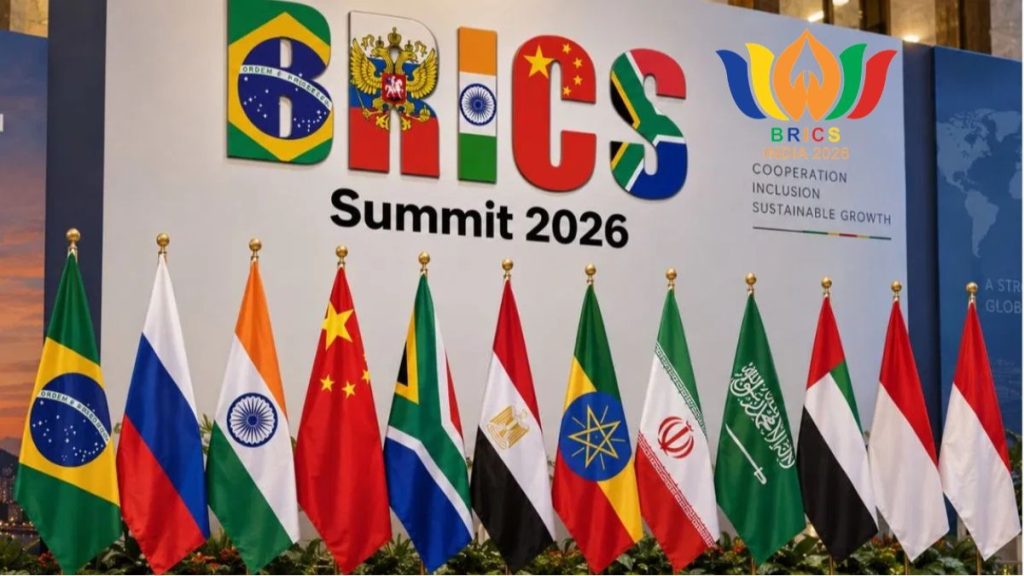
Africa is taking a more prominent position in the BRICS grouping as leaders meet in New Delhi for the 18th BRICS Summit, with the expanded bloc seeking to strengthen economic cooperation among emerging economies and give developing countries a greater voice in global affairs.
India is hosting the summit on September 12–13 under the theme “Building for Resilience, Innovation, Cooperation and Sustainability.” The expanded BRICS now includes 11 members, among them three African countries: South Africa, Egypt and Ethiopia.
The growth of African representation marks a significant change from the bloc’s original structure. South Africa joined in 2011, while Egypt and Ethiopia became members in 2024. Their participation gives Africa a broader presence in discussions covering finance, trade, energy, technology and reform of international institutions.
For African economies, the significance of BRICS extends beyond political symbolism. The bloc has increasingly presented itself as a platform for South-South cooperation, including alternative sources of development finance, investment and technology partnerships.
One of the bloc’s most important institutions is the New Development Bank (NDB), which was created by BRICS and has financed nearly $43 billion in projects, according to Reuters. The bank has become an important mechanism for financing infrastructure and development projects outside traditional Western-led financial institutions.
Africa seeks more financing and trade
African members are particularly interested in expanding access to development finance and investment as governments across the continent seek to close infrastructure, energy and industrialisation gaps.
The 2026 summit is taking place as BRICS members discuss initiatives on supply-chain cooperation, energy security, digital infrastructure and artificial intelligence. India has also been working on proposals including a BRICS startup innovation fund and a logistics and supply-chain cooperation framework.
For Africa, stronger supply-chain cooperation could have implications for manufacturing, agriculture and mineral processing, particularly as countries seek to move beyond exporting raw materials and capture more value domestically.
The continent also holds some of the world’s most important reserves of critical minerals needed for batteries, renewable-energy technologies and advanced manufacturing. Greater cooperation with BRICS economies could create opportunities for African countries to attract investment into processing and manufacturing rather than remaining primarily exporters of unprocessed resources.
A bigger voice in global governance
Africa’s BRICS participation also comes amid long-standing calls for reforms to institutions such as the United Nations, the International Monetary Fund and World Bank.
BRICS members have repeatedly called for a more representative international system, arguing that developing countries remain underrepresented in institutions that shape global economic and political decisions.
The expanded bloc now represents more than 40% of the world’s population and nearly a quarter of global GDP, according to Reuters, giving its members significant collective weight in discussions about the global economy.
For African governments, the challenge is turning that collective weight into concrete outcomes — including improved access to finance, technology transfer, market access and greater representation in global decision-making.
Technology and the next phase of cooperation
Technology is emerging as another area where Africa could benefit from deeper BRICS cooperation.
Chinese President Xi Jinping used the 2026 summit to call for stronger economic and technological cooperation within what he described as the “Greater BRICS” grouping. China has proposed initiatives including a BRICS AI Open Source Zone and greater cooperation on industrial supply chains and services trade.
For African economies undergoing rapid digitalisation, cooperation in artificial intelligence, cloud computing, digital payments and technology infrastructure could help expand access to tools needed for productivity and innovation.
But African governments also face the challenge of ensuring that such partnerships result in local skills development, technology transfer and domestic value creation rather than simply expanding markets for foreign companies.
Africa’s opportunity and the challenge
The expansion of BRICS gives Africa a larger platform, but membership alone does not guarantee economic gains.
South Africa, Egypt and Ethiopia have different economic structures, foreign-policy priorities and development needs. Their ability to coordinate African interests within BRICS will therefore be important if the continent is to secure broader benefits from the bloc.
The African opportunity lies in using BRICS relationships to attract investment, expand trade, improve infrastructure financing, strengthen industrial capacity and secure a greater role in emerging sectors such as artificial intelligence and critical minerals.
The challenge is ensuring that these partnerships support Africa’s own development priorities.
As BRICS becomes larger and more influential, Africa’s role within the grouping is moving from being represented by a single major economy to having three members with different regional and economic perspectives.
That gives the continent a stronger voice. The measure of the 2026 summit, however, will ultimately be whether that voice translates into investment, jobs, infrastructure, technology and greater economic opportunities for African countries.