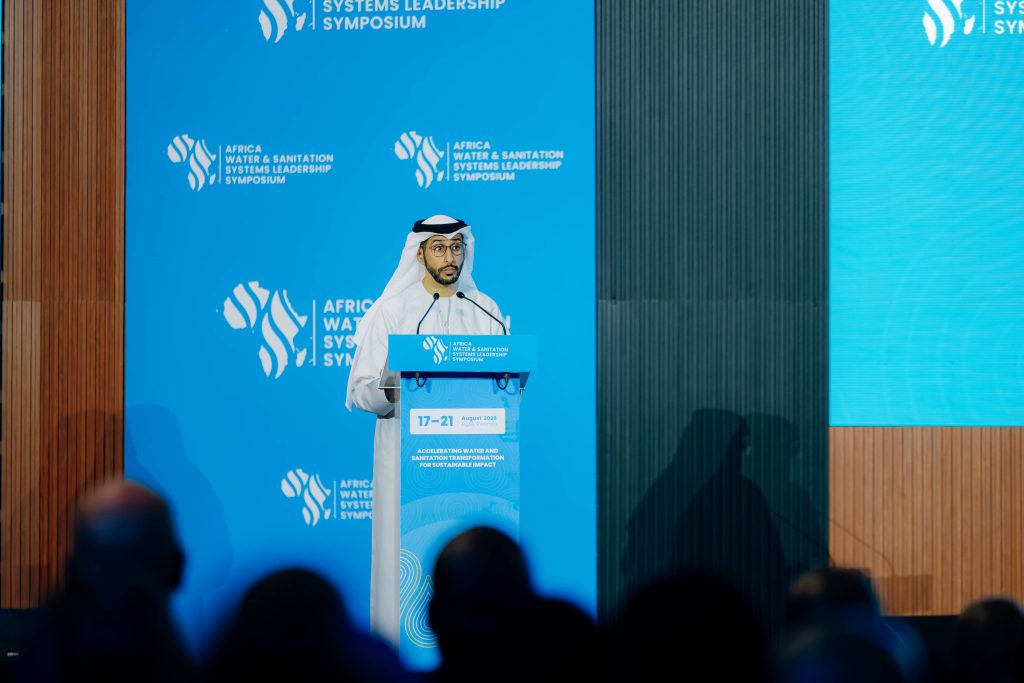
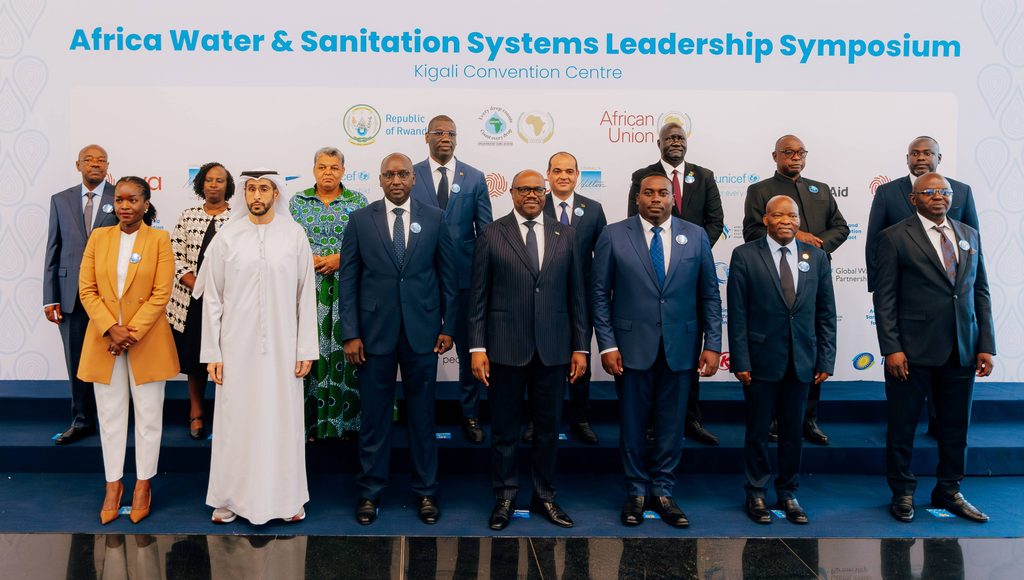
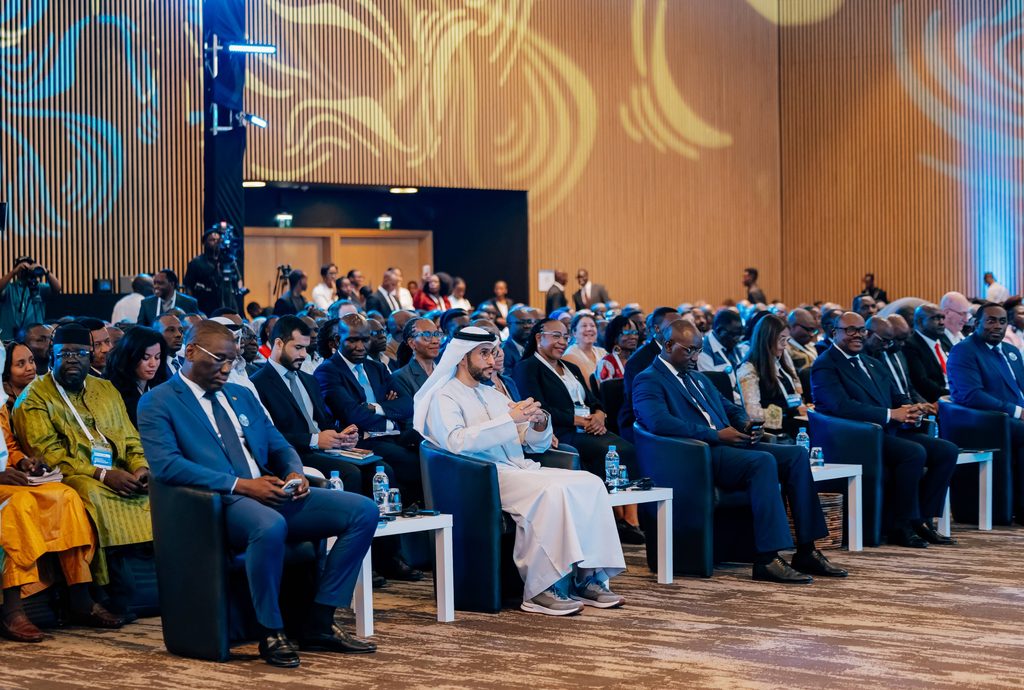
KIGALI, Rwanda, 19 August 2026. In his opening remarks at the Africa Water & Sanitation Systems Leadership Symposium 2026 at the Kigali Convention Centre, His Excellency Abdulla Ahmed Balalaa, the United Arab Emirates’ Assistant Minister of Foreign Affairs for Energy and Sustainability, delivered a clear and powerful message: the era of talking about water is over, and what remains is the harder work of implementation.
“The challenge before us is no longer one of ambition,” H.E. Balalaa said. “The challenge is implementation.” The collective task now, he said, was to mobilise the partnerships, finance, technology and political leadership needed to convert commitments into measurable outcomes for communities across the continent, a point he repeated in near-identical terms in a same-day interview with the broadcaster EMG TV.
The five-day Symposium, running from 17 to 21 August under the banner ‘Accelerating Water and Sanitation Transformation for Sustainable Impact’, has been jointly organised by the African Union, the African Ministers’ Council on Water (AMCOW) and the Government of Rwanda, and facilitated by Riva. It forms part of the African Union’s designated Year on Water and Sanitation, and is expected to draw more than 1,000 political, financial and technical leaders from across Africa and beyond. Its outcomes are intended to feed directly into Africa’s common negotiating position ahead of the 2026 UN Water Conference and to help operationalise the Africa Water Vision 2063.
That link between Kigali and Abu Dhabi ran through everything H.E. Balalaa said in Rwanda. He congratulated the African Union for elevating “Sustainable Water Availability and Safe Sanitation Systems” as this year’s continental theme under Agenda 2063, and traced a chain of preparatory milestones the UAE has taken part in over the past year: the WASH Forum on the sidelines of the AU Summit in Addis Ababa, the Africa Water Investment Summit in Cape Town, and the High-Level Preparatory Meeting in Dakar, which drew close to 3,000 participants from more than 120 countries. Those gatherings, he said, were building the roadmap that “will carry us to Abu Dhabi this December”. Africa, he added, is “central” to that conference, and he said he was glad to be in Rwanda both to make that case and to meet counterparts across foreign ministries and the water sector who will help carry it forward.
H.E. Balalaa did not understate the scale of the deficit, calling the widely tracked figure of 2.1 billion people worldwide lacking safely managed drinking water “shocking”. In his prepared remarks, he set that alongside the companion figure for sanitation: under the latest WHO/UNICEF Joint Monitoring Programme data, published in 2025, 3.4 billion people still lack safely managed sanitation. Closing that gap carries its own daunting price tag: the World Bank and the 2030 Water Resources Group estimate a global water-infrastructure financing gap of $6.7 trillion by 2030, rising to $22.6 trillion by 2050, against a sector that today draws only a fraction of global public and private investment. Multilateral development banks have a role to play in closing it, H.E. Balalaa said, but access to their earmarked water funds carries conditions, and the banks themselves need to focus on de-risking capital for member states rather than financing alone.
He also cast that deficit as an opportunity rather than only a burden. Water, he said, is “not only a development imperative. It is an economic imperative” and “the main enabler for… any successful economy”. The stakes are especially high in labour-intensive, water-dependent sectors such as agriculture, which by one widely cited estimate accounts for 62 percent of total employment in sub-Saharan Africa. Solving water insecurity, H.E. Balalaa argued, is therefore inseparable from job creation for the continent’s youth, whom he called “the driving force for any successful country, continent or even economy” and who make up what he described as “the highest youth population globally”.
H.E. Balalaa pointed to a series of concrete UAE commitments as evidence of that argument being put into practice rather than merely rhetoric. Two years after its founding, the Mohamed Bin Zayed Water Initiative, on whose board H.E. Balalaa sits, has channelled a $150 million investment into the XPRIZE Water Scarcity competition, a five-year, $119 million prize purse launched in March 2024 to accelerate affordable, deployable desalination technology. In January 2026, the Abu Dhabi Fund for Development (ADFD) launched the Abu Dhabi Global Water Platform, aiming to mobilise up to $2 billion from local and international financing institutions, with an initial $1 billion committed by ADFD between 2026 and 2030 targeting roughly 10 million beneficiaries worldwide.
Closer to home for his Rwandan hosts, H.E. Balalaa cited the Abu Dhabi Fund for Development’s December 2024 financing agreement with the Government of Rwanda, a $25 million (AED 92 million) loan to expand water transmission and distribution systems at the Karenge Water Treatment Plant, as a “testament” to what bilateral partnership between the UAE and an African nation can deliver. “We want this to serve as an example,” he said, “on how a great bilateral relationship between two countries… can be fruitful in addressing an important subject such as water security elsewhere as well.”
H.E. Balalaa also laid out the shape of the December gathering his country will co-host with Senegal. The 2026 UN Water Conference, the third such UN conference dedicated to water in 50 years, will convene in Abu Dhabi from 8 to 10 December, structured around six Interactive Dialogues whose themes were adopted by consensus at the UN General Assembly in 2025. Beyond Senegal as co-host, four additional African countries are leading as co-chairs of those dialogues, part of a 12-member group of co-chairs he said would “bring the full spectrum of the cycle” to respond to demand-side commitments made by governments. The UAE has also partnered with UNESCO to bring 100 young people into the Conference process, which H.E. Balalaa said was designed to ensure youth “have a seat on the table”, not merely observer status.
Across both his remarks and his interview, H.E. Balalaa was careful to frame the December Conference’s success in terms of legacy rather than ceremony. “We want to see projects, we want to see partnerships, we want to see policies formed,” he said, adding that its success “will not be measured by what we say in Abu Dhabi… but by what we help deliver afterwards.”
He closed his Kigali remarks by invoking the words of Sheikh Abdullah bin Zayed Al Nahyan, Deputy Prime Minister and Minister of Foreign Affairs, who said in 2023 “no nation will be immune from the cascading effects of unmitigated water scarcity”, before returning, in his broadcast interview, to the line that has become the Conference’s own tagline: every future flows from water. For the delegations now working through five days of technical and ministerial sessions in Kigali, the message from the UAE’s delegation was that the road to Abu Dhabi runs directly through the reforms, governance and investment pipelines they build this week.