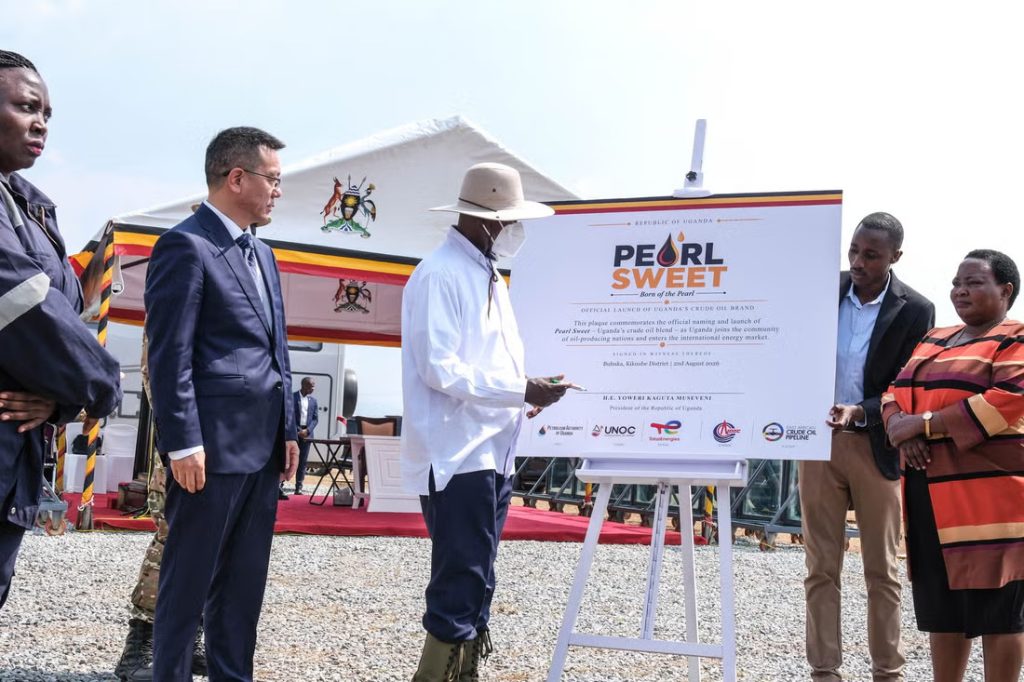
Uganda has named its blended crude oil grade “Pearl Sweet”, marking a key milestone as the East African country prepares to begin commercial oil production by the end of 2026.
President Yoweri Museveni unveiled the name on Wednesday during a ceremony in Kikuube District, about 250 kilometres west of Kampala.
Museveni said “Sweet” refers to the crude’s relatively low sulphur content, while “Pearl” draws on Uganda’s long-standing description as the “Pearl of Africa”, a phrase popularised by former British Prime Minister Winston Churchill.
Uganda discovered commercially viable oil reserves about two decades ago in the Albertine Rift Basin, near its border with the Democratic Republic of Congo. However, the start of production has been repeatedly delayed by infrastructure challenges and disagreements between the government and international oil companies over the development of the fields.
The country’s recoverable oil reserves are estimated at 1.65 billion barrels, with peak production projected at around 230,000 barrels per day.
The oil fields are being developed by a consortium led by France’s TotalEnergies, which holds a 56.67% stake, alongside China’s CNOOC, with 28.33%. The remaining 15% is held by the state-owned Uganda National Oil Company (UNOC).
Following the crude’s official naming, UNOC said companies involved in the project would begin market-related activities, including approaching refineries, conducting market intelligence and negotiating commercial arrangements with potential buyers.
Uganda plans to export Pearl Sweet through the East African Crude Oil Pipeline (EACOP), a 1,443-kilometre pipeline connecting the country’s oil fields to the Tanzanian port of Tanga on the Indian Ocean.
The approximately $5 billion pipeline is designed to transport Uganda’s crude for export to international markets and is described as the world’s longest electrically heated crude oil pipeline.
UNOC said Pearl Sweet has characteristics broadly comparable to other waxy, low-sulphur crude blends produced in the region, including Chad’s Doba crude and the Nile and Dar blends associated with South Sudan and Sudan.
The naming of the crude grade comes as Uganda moves toward the final stages of preparations for commercial production, an objective that has been delayed for years since the discovery of the country’s oil resources.
The beginning of production is expected to mark a significant shift in Uganda’s energy sector, with oil exports potentially creating a new source of foreign exchange and government revenue while integrating the country more closely into East Africa’s regional energy and transport infrastructure.