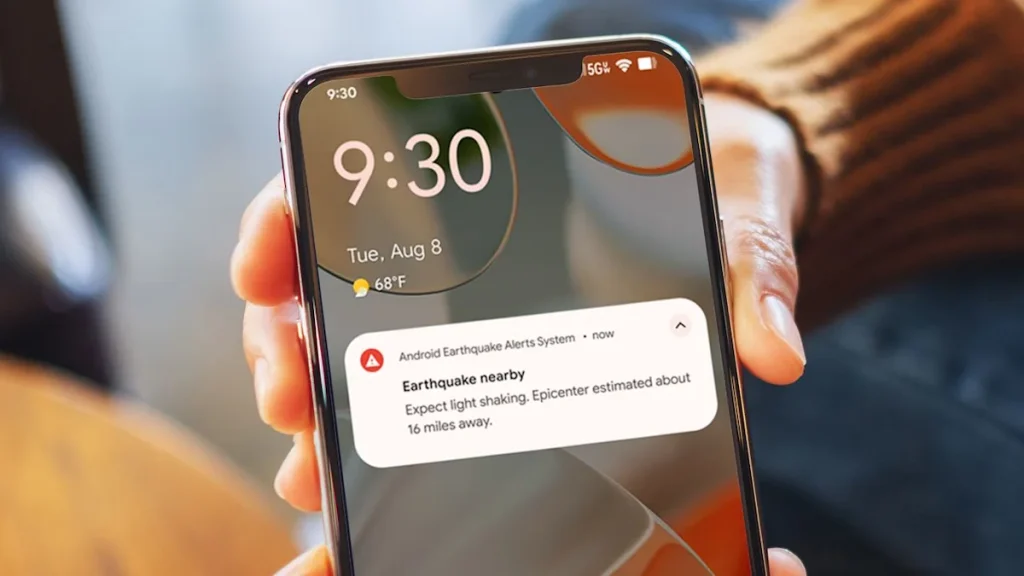
Millions of people in Venezuela received warnings before the powerful earthquakes that struck the country on June 24, thanks to Google’s built-in Android Earthquake Alerts System, highlighting the growing role of smartphones in disaster preparedness.
According to figures reported by Google, the system sent early warnings to approximately 11.4 million Android users, with some receiving alerts up to two minutes before strong ground shaking began.
Google said the first alerts were issued just nine seconds after the earthquake originated underground, giving people valuable time to seek safety before the most damaging seismic waves arrived.
The Android Earthquake Alerts System, introduced in 2021, turns millions of Android smartphones into a global earthquake detection network. The technology uses motion sensors, known as accelerometers, built into smartphones to detect the fast-moving but weaker primary waves (P-waves) that travel ahead of the stronger and more destructive secondary waves (S-waves).
When multiple stationary Android devices detect similar ground movement, anonymized data is automatically sent to Google. If enough matching signals are received, the system rapidly estimates the earthquake’s location and magnitude before sending alerts to users who may be affected.
To reduce false alarms, only stationary phones are used to detect earthquakes, and alerts are triggered only for earthquakes measuring magnitude 4.5 or higher. The system performs particularly well in densely populated areas where more Android devices contribute data.
In the United States, Android users in California, Oregon, and Washington receive earthquake alerts through the ShakeAlert system operated by the U.S. Geological Survey (USGS), which relies on a network of more than 1,600 seismic sensors rather than smartphone data.
Google says the Earthquake Alerts System is currently available in 98 countries and is enabled by default on most modern Android devices. Users can verify the setting by navigating to Settings > Safety and emergency > Earthquake alerts.
Depending on a user’s distance from the earthquake’s epicentre, alerts vary in urgency. The highest-level warnings override Do Not Disturb settings, sound a loud alarm, and display a full-screen notification urging users to take immediate protective action.
Since its launch, Google says the system has detected more than 18,000 earthquakes worldwide and issued over 2,000 public alerts, extending earthquake early-warning capabilities to an estimated 2.5 billion people, including many living in countries without government-operated warning systems.
Apple’s iPhone does not currently include a comparable global earthquake detection network. Instead, iOS devices relay official emergency notifications issued by government authorities where such systems exist.
While it remains unclear how many lives were saved during the earthquakes in Venezuela, experts say even a few seconds of warning can allow people to move away from dangerous structures, stop vehicles safely, or take protective cover before strong shaking begins, reducing the risk of injury and death during major seismic events.