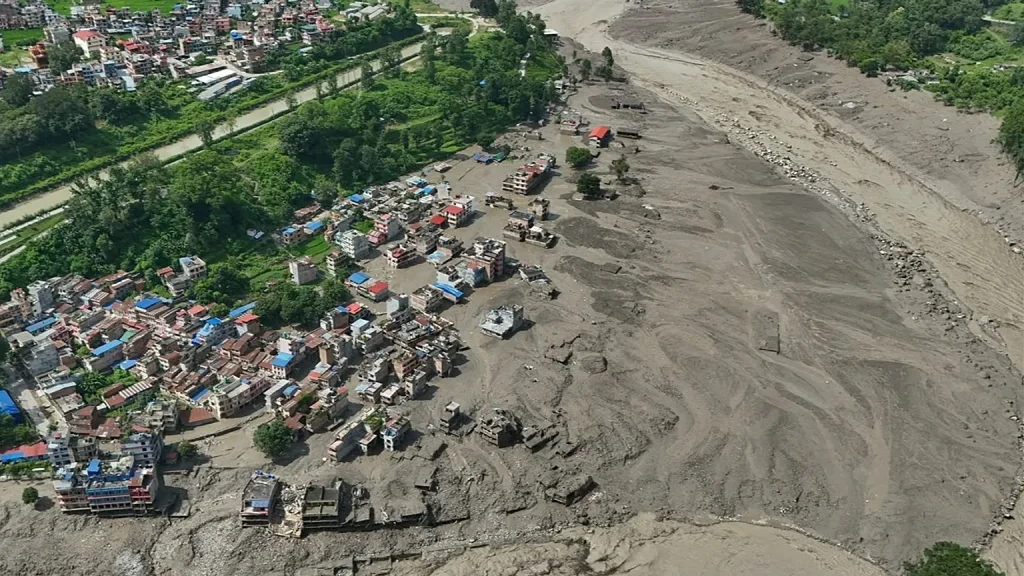
Massive landslides and flash floods along the Nepal-Tibet border have caused widespread destruction, killing at least 160 people and leaving hundreds more missing, as search and rescue operations continue across affected areas.
Nepalese authorities have recovered 157 bodies, while Chinese state media has reported at least three deaths on the Tibetan side of the border. Officials have warned that the final toll could be significantly higher as rescue teams reach areas cut off by debris and floodwaters.
The disaster has swept through northern Nepal, affecting communities, roads and infrastructure near the border. A large volume of mud, rocks and other debris reportedly surged into populated areas, destroying buildings and vehicles and forcing residents to flee.
Several major rivers, including the Bhote Koshi, Trishuli and Narayani, have also experienced severe flooding, raising concerns about further damage downstream.
Cause remains unclear
The exact cause of the disaster remains under investigation.
Nepal’s foreign minister initially said an earthquake had been reported near the Nepal-Tibet border shortly before the landslide, raising the possibility that seismic activity triggered the collapse.
However, an updated analysis by the U.S. Geological Survey indicated that there was no earthquake associated with the event, leaving scientists investigating other possible causes.
Heavy rainfall, melting ice or the sudden release of water from a glacial lake are among the possibilities being examined. Scientists are also assessing whether unstable ground conditions contributed to the collapse.
The disaster comes as the Hindu Kush Himalaya region experiences rapid environmental changes, including accelerating glacier melt linked to rising temperatures. Scientists, however, caution that it is too early to establish a direct connection between climate change and this particular disaster.
Researchers are expected to examine satellite imagery, rainfall records, river conditions and evidence of possible glacial lake drainage to reconstruct how the disaster unfolded.
Foreign nationals among those missing
The scale of the missing population remains uncertain.
Nepal’s tourism authorities estimate that 403 people are missing, including 341 foreign nationals, many of them believed to be from India. People from 26 countries are reportedly among those caught up in the disaster, including citizens of the United States and United Kingdom.
The affected region is also known for mountaineering, trekking and religious tourism, increasing concerns about the number of visitors who may have been in the area when the disaster struck.
Rescue operations intensify
Nepal has launched search and rescue operations while coordinating with authorities in China as both countries assess damage along the border.
Nepal’s prime minister described the disaster as a national shock and said government agencies would work together to support the affected communities.
Chinese President Xi Jinping has called for an intensive search and rescue operation and stronger monitoring and early-warning systems to reduce the risk of further casualties.
India has also offered humanitarian assistance, with Prime Minister Narendra Modi saying his government is prepared to provide Nepal with support.
The United Kingdom has pledged assistance to its nationals affected by the disaster.
With roads and other transport links damaged in several areas, rescue teams face difficult terrain and the continuing threat of flooding and further landslides. Authorities are expected to provide updated casualty figures as search operations progress.