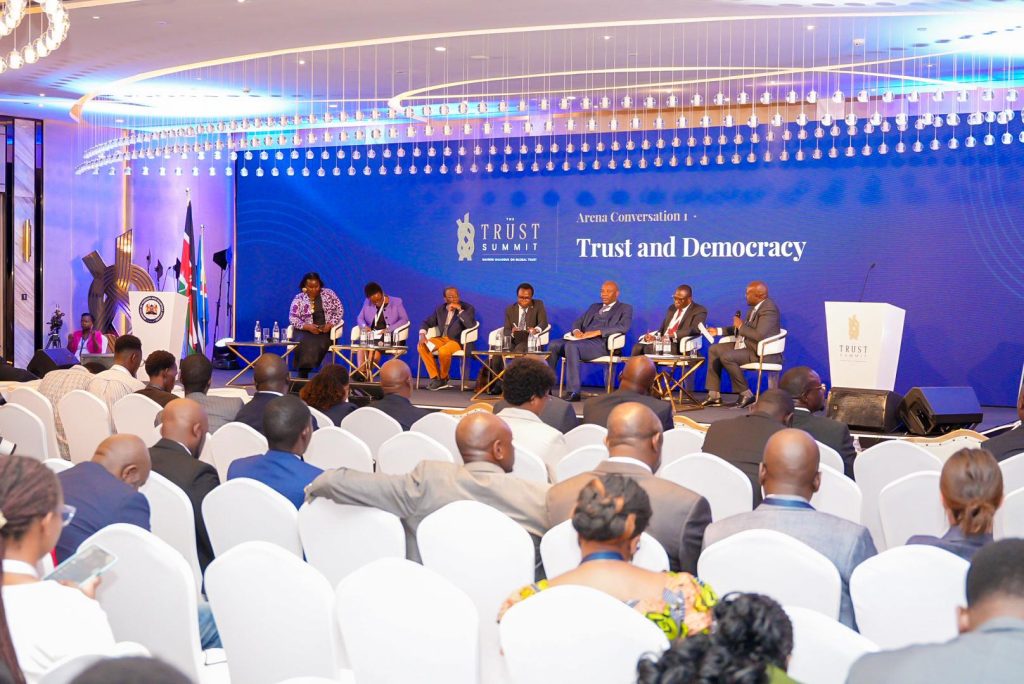
African and international leaders are calling for stronger accountability, meaningful public participation and measurable results from public institutions as the Global Trust Summit: Nairobi Dialogue on Global Trust examines declining confidence in governance and international cooperation.
Opening discussions on Wednesday focused on the need for institutions to earn public confidence through reliable services, credible information and commitments that translate into action.
“This is not a summit of convenience. It’s a summit of necessity,” said Dr Abraham Korir Sing’Oei, Kenya’s Principal Secretary for Foreign Affairs, highlighting the urgency of rebuilding trust amid inequality, geopolitical tensions and declining confidence in institutions.
The summit, running from October 21 to 23 under the theme “Weaving Trust: Binding Strands for a Stronger Global Order,” brings together governments, businesses, multilateral institutions, civil society, academics and young people to explore practical ways to restore confidence in public institutions and markets.
Participants argued that transparency alone is insufficient if information does not lead to action. Auditor-General Nancy Gathungu said trust depends on credible information and accountability throughout the public sector, while Dorothy Jemator Kimengech, vice-chairperson of the Commission on Administrative Justice, stressed the importance of helping citizens understand institutional responsibilities and projects.
Kenya Bureau of Standards Chief Executive Esther Ngari highlighted how institutional performance shapes public confidence.
“When standards work, no one recognizes, but when they fail, that is when questions arise,” she said.
Public participation also emerged as a central theme. Duncan Ojwang’, chairperson of the Independent Policing Oversight Authority, said participation should be inclusive rather than dominated by the loudest voices.
“Let us not turn public participation to the noisiest; let it be universal,” he said.
Sheila Masinde, executive director of Transparency International Kenya, said public participation should be treated as a democratic right, while Caroline Gaita, executive director of Mzalendo Trust, warned that consultations risk becoming symbolic without a mechanism for responding to citizens.
“Participation without a feedback loop is not engagement; it’s attendance,” Gaita said.
The discussions also examined the relationship between trust, economic growth and investment. Clare Akamanzi, chief executive of NBA Africa, said public announcements must be supported by evidence that institutions can deliver on their promises.
Venture capitalist Sean Karanja stressed the importance of integrity in business, saying he wanted to “deploy truthful capital to truthful entrepreneurs.” He also warned that if African institutions fail to publish their own research and data, global artificial intelligence systems may reinforce incomplete or externally shaped narratives about the continent.
Judicial independence and access to justice were also raised as essential elements of public trust. Participants stressed that constitutional guarantees must translate into real access to services and legal protections, regardless of citizens’ financial circumstances or location.
Beyond national governance, the summit is addressing Africa’s representation in international decision-making. The continent continues to call for a stronger voice in global institutions, including the United Nations Security Council, and in decisions affecting development finance, debt, climate action and international security.
Discussions are also exploring how regional frameworks, including the East African Community and the African Continental Free Trade Area, can strengthen cooperation and support African-led solutions.
A proposed Nairobi Call to Action on Global Trust aims to turn the summit’s discussions into commitments that can be tracked beyond the meeting. Participants are also examining how trust intersects with youth participation, gender, disability, displacement, faith and communities historically excluded from decision-making.
Awel Uwihanganye, chief executive of The Trust Summit, urged young Africans to take an active role in shaping the continent’s future and strengthening confidence in African institutions.
“Let us trust one another until we are given a reason not to,” he said.
Amason Jeffah Kingi, Speaker of Kenya’s Senate, offered a practical definition of trust: “Trust is a belief that my legitimate expectations will be met within a reasonable time.”
As the summit concludes on October 23, its impact will depend on whether participating institutions turn those principles into measurable improvements in public services, accountability, economic opportunity, and international cooperation.