Kenya is heading into the 2027 General Election with public confidence under significant strain, as a new TIFA Research survey finds widespread dissatisfaction with the country’s direction alongside persistent economic pressure on households.
76 per cent of Kenyans say the country is headed in the wrong direction, the highest level recorded during TIFA’s tracking period, while 65 per cent say their personal or household economic situation has worsened since the 2022 General Election.
The survey, released on Wednesday, September 9, 2026, recorded the highest level of dissatisfaction with the country’s direction during TIFA’s tracking period, nearly four years after President William Ruto came to power.
Only 15 per cent of respondents said Kenya is moving in the right direction, while eight per cent said the country is moving neither in the right nor wrong direction.
The negative assessment of the country’s direction is accompanied by widespread concern about household finances, with 65 per cent of Kenyans saying they are worse off economically than they were before the 2022 General Election. Only 12 per cent reported an improvement in their personal or household economic situation, while another 23 per cent said their circumstances had remained unchanged.
The survey shows that economic pressures remain at the centre of public dissatisfaction.Unemployment and poverty were identified as the country’s most serious problems by 44 per cent of respondents, while another 25 per cent cited inflation, high prices and high taxes.
Combined, 69 per cent of respondents identified issues directly linked to economic hardship as major concerns, compared with 19 per cent who cited corruption.

The employment figures provide another indication of the pressure facing households. The combined proportion of Kenyans reporting full-time employment, part-time or casual work and self-employment fell from 63 per cent in November 2025 to 58 per cent in June 2026.
Compared with the period around the 2022 General Election, full-time employment increased from 14 per cent to 16 per cent, while part-time or casual employment rose from six per cent to eight per cent. Self-employment and business activity increased from 29 per cent to 32 per cent.
However, unemployment also increased, rising from 18 per cent around the 2022 election period to 20 per cent in June 2026.The survey also points to limited growth in household earnings, with only 11 per cent of households reporting monthly incomes above KSh50,000.
At the lower end of the income scale, 23 per cent of households reported earning less than KSh10,000 a month, while 20 per cent earned between KSh10,000 and KSh19,999. Another 17 per cent reported monthly incomes between KSh20,000 and KSh29,999. TIFA noted that average monthly incomes have changed little across its four most recent surveys, although the proportion of households earning below KSh10,000 declined from 29 per cent a year earlier to 23 per cent.
The polling firm cautioned that income levels should also be considered alongside inflation, which was around four per cent in 2025 but had risen to nearly seven per cent around the time of the survey, putting further pressure on household purchasing power.
The findings come as Kenya moves closer to the 2027 General Election, placing economic conditions and the country’s direction at the centre of an increasingly important political debate.
For the government, the figures point to a challenge that goes beyond public perception, with TIFA highlighting the need for job creation across both formal and informal sectors, including wage employment, casual work and self-employment.
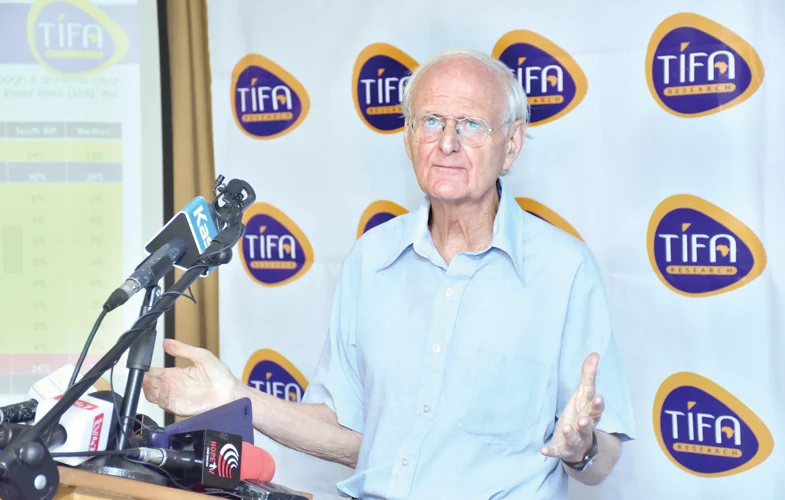
The survey was conducted between June 13 and 22, 2026, through face-to-face household interviews with 2,048 randomly selected Kenyan adults across all 47 counties. TIFA puts the margin of error at plus or minus 2.18 percentage points.
While the findings reveal widespread dissatisfaction, they also provide a clear measure of what could change public sentiment: stronger employment opportunities, improved household incomes and relief from the cost pressures affecting everyday life.