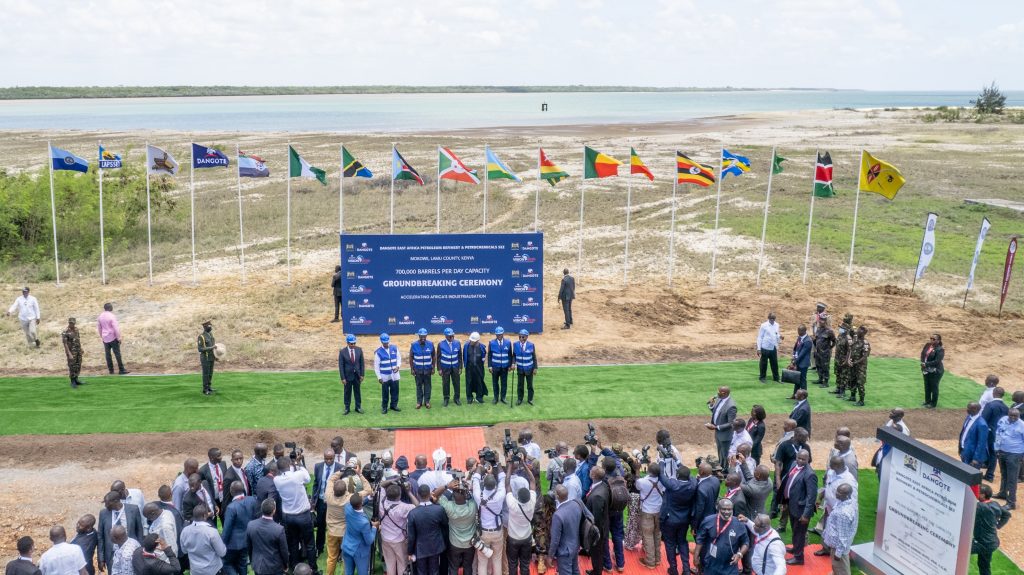
African leaders gathered in Kenya’s coastal town of Lamu on Wednesday for the groundbreaking of a $16 billion Dangote East Africa Refinery, a project expected to become one of the region’s largest industrial investments and reduce dependence on imported refined fuel.
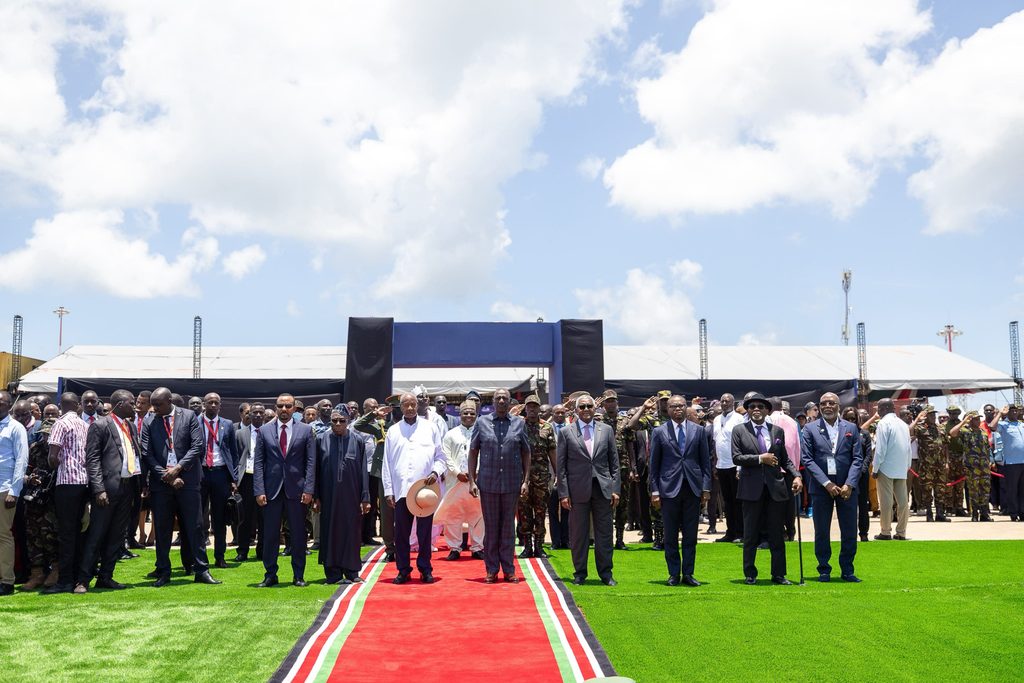
Kenyan President William Ruto hosted Nigerian industrialist Aliko Dangote at the ceremony, which was attended by Ugandan President Yoweri Museveni, Ethiopian Prime Minister Abiy Ahmed, President of the Republic of Benin Romuald Wadagni, Togolese President Jean-Lucien Savi de Tové, former Nigerian President Olusegun Obasanjo and other senior African officials. Rwanda, Burundi, South Sudan and Tanzania were also represented by high-level delegations.
The refinery is planned to process 700,000 barrels of crude oil per day when completed, with Dangote saying construction is expected to take about 40 months. The facility is intended to supply petroleum products to Kenya and other East African markets, helping reduce the region’s reliance on imported refined fuels.
The project will be built at Lamu Port, which is part of Kenya’s Lamu Port-South Sudan-Ethiopia Transport (LAPSSET) Corridor. The location gives the refinery access to deep-sea infrastructure and a developing transport corridor connecting Kenya’s northern region with neighbouring countries.
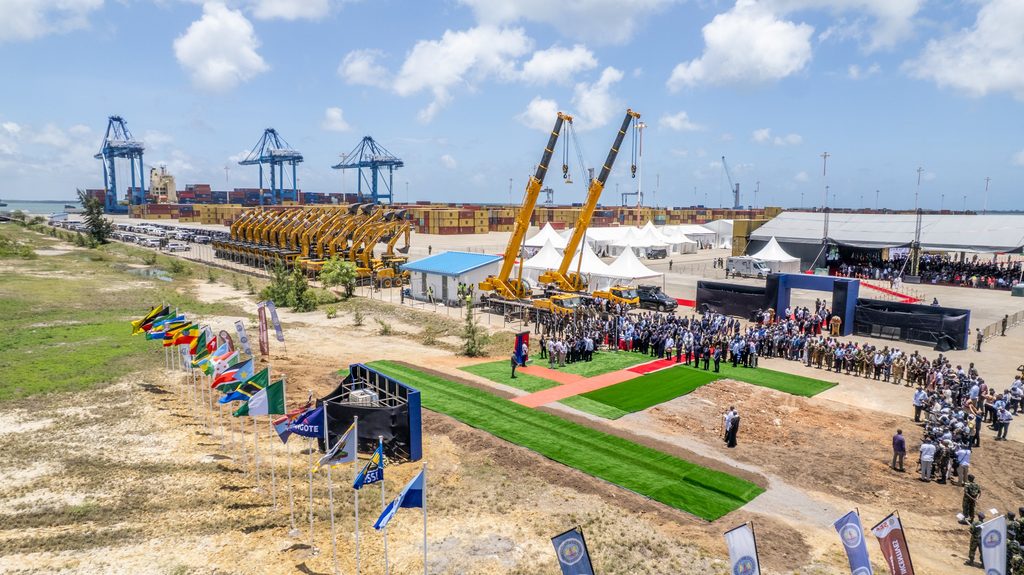
The scale of the development was already becoming visible before the ceremony. A vessel carrying about 2,930 tonnes of heavy construction machinery arrived at Lamu Port days before the groundbreaking, providing the first major equipment for the project.
Leaders call for deeper African integration
The ceremony became more than the launch of an energy project, with leaders using the occasion to argue for stronger economic integration across Africa.
President William Ruto thanked President Museveni for his support and described investors as partners in national development.
“Investors are our partners in the development of our nations, not our enemies,” Ruto said, while assuring Dangote that Kenya would provide a different investment environment.
Prime Minister Abiy Ahmed said East Africa should not be viewed simply as a market for foreign products, but as a place where Africans can build industries and develop technical expertise.
“Young Africans should not remain observers of projects like this,” Abiy said. “They should become the engineers and contractors.”
Museveni used the ceremony to renew his call for an East African political federation, arguing that deeper integration would make it easier for goods and resources to move across national borders.
“We need to look again at the political federation of East Africa,” Museveni said, pointing to Nigeria’s large internal market as an example of the potential benefits of removing barriers between neighbouring economies.
Former Nigerian President Olusegun Obasanjo described the gathering as an important moment bringing East and West Africa closer together.
“I am happy that I see this day where East Africa and West Africa are being brought together with the commitment of our leaders and with the courage and commitment of one man: Aliko Dangote,” Obasanjo said.
Dangote offers regional stake
Dangote said the refinery was designed not only for Kenya but for the wider East African market.
He said 30% of the project would be earmarked for governments in the region, allowing neighbouring countries to participate directly in the refinery’s ownership.
The project is expected to process crude from regional and other African producers. Its promoters also expect the refinery to support related industries, including petrochemicals, fertiliser, chemicals and packaging, while creating tens of thousands of jobs.
Dangote said the wider objective was to increase Africa’s capacity to process its own natural resources.
“For too long, our continent has been rich in resources but poor in value addition,” he said, arguing that Africa cannot achieve lasting prosperity by exporting raw materials and importing finished products.
A major project with challenges ahead
The refinery is expected to help meet a great regional demand for petroleum products. Regional consumption is estimated at between 20 million and 30 million metric tonnes annually, according to Kenyan officials cited by Reuters.
But the project also faces questions over the availability of crude supplies, regional energy infrastructure and its environmental impact.
Environmental campaigners and residents have raised concerns about potential effects on Lamu’s fragile marine environment and the Lamu Old Town World Heritage site. Kenya’s High Court has ordered preservation of parts of the site while a legal case brought by residents proceeds.
Despite those challenges, the groundbreaking marks the formal beginning of construction of a project that its promoters see as a potential regional energy and industrial hub.
For the leaders gathered in Lamu, however, the significance extended beyond the refinery itself: the ceremony became a platform for a broader vision of an Africa that processes more of its own resources, trades more across its borders and builds industrial capacity through African capital, skills and partnerships.