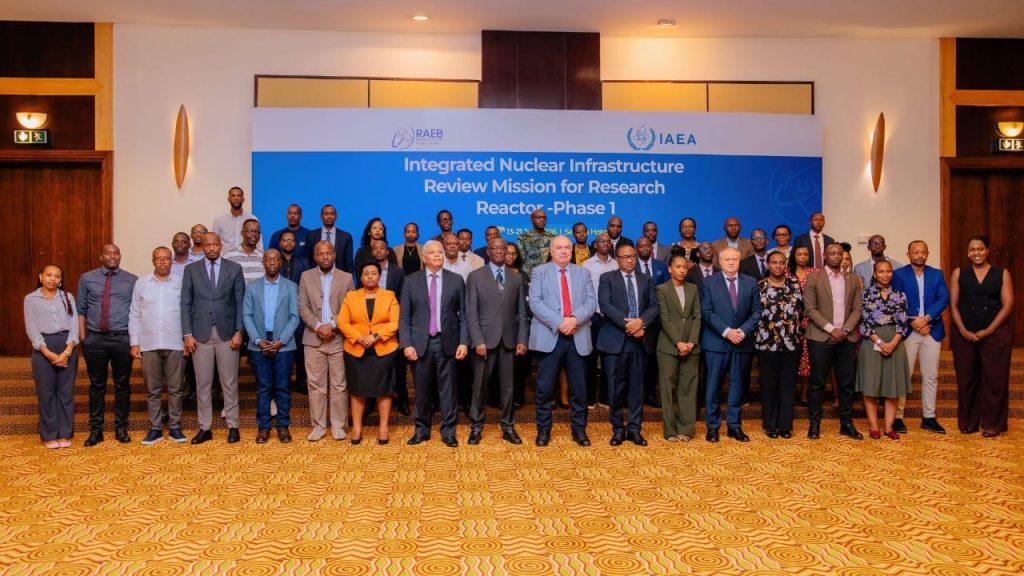
Rwanda has taken another significant step in its nuclear development journey following the conclusion of an International Atomic Energy Agency (IAEA) Integrated Nuclear Infrastructure Review for Research Reactors (INIR-RR), a mission aimed at assessing the country’s readiness to develop its first research reactor.
The review, conducted from July 13 to 21, forms part of Rwanda’s broader strategy to harness nuclear science and technology to support healthcare, agriculture, industry, environmental protection and future energy security.
The proposed research reactor will form part of the Centre for Nuclear Science and Technology, which Rwanda plans to establish in Bugesera District. The facility is expected to serve as a hub for scientific research, workforce training, medical isotope production and the development of nuclear expertise needed to support the country’s long-term nuclear ambitions. It will also provide laboratories and specialised infrastructure to advance applications of nuclear science in areas such as healthcare, agriculture, industry and environmental research.
Speaking at the close of the mission, Rwanda Utilities Regulatory Authority (RURA) Director General Dr. Evariste Rugigana said nuclear technology offers benefits that extend far beyond electricity generation.
“The benefits of nuclear technology extend across multiple sectors and align with the country’s national development priorities,” Rugigana said.
He noted that nuclear applications could improve disease diagnosis and treatment, strengthen food security through agricultural research, enhance industrial productivity and innovation, support environmental protection and improve water resource management.
“In the long term, it also expands the country’s options for clean, reliable and secure energy,” he added.
Rugigana emphasized that Rwanda’s nuclear programme is fundamentally about building national capacity.
“Our commitment is clear: we are not simply investing in technology we are investing in national capability. We are building the institutions, developing the expertise and strengthening the partnerships that will enable nuclear science and technology to transform our country in meaningful ways,” he said.
The IAEA mission follows an earlier Integrated Nuclear Infrastructure Review conducted in March 2026, which assessed Rwanda’s nuclear power programme and identified strong government commitment and stakeholder engagement as areas of progress.
IAEA Deputy Director General Mikhail Chudakov described the research reactor as a crucial foundation for Rwanda’s future nuclear power programme.
“A research reactor is the foundation of that journey. It is where regulators learn to regulate in practice. It is where licensing and training move beyond documents to real-world implementation,” Chudakov said.
He added that the reactor would support the production of medical isotopes for healthcare while advancing research in agriculture, mining and materials science.
Rwanda aims to commission its first Small Modular Reactor (SMR) in the 2030s and significantly increase the role of nuclear energy in its electricity mix by 2050.
Chief Executive Officer of the Rwanda Atomic Energy Board (RAEB), Dr. Fidèle Ndahayo, said the mission’s findings would help guide the next phase of development.
“The recommendations and observations shared during this mission will serve as an important roadmap as we continue strengthening our national nuclear infrastructure,” Ndahayo said.
As Rwanda advances its nuclear agenda, officials say the Centre for Nuclear Science and Technology in Bugesera will play a critical role in developing the expertise, infrastructure and regulatory experience required to deploy nuclear technologies for national development safely.