

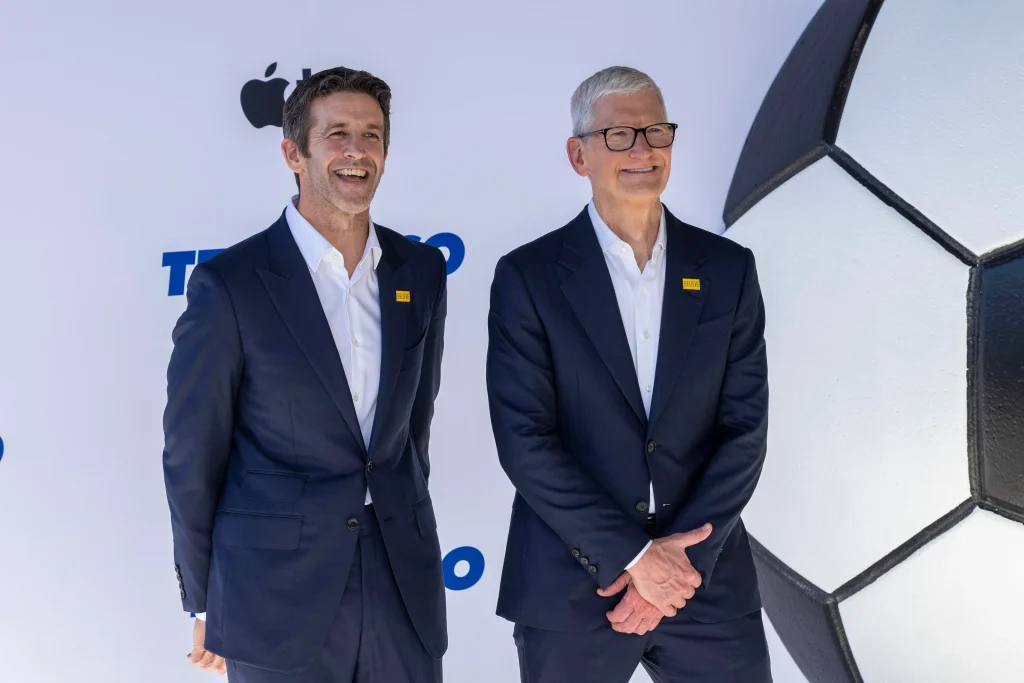
John Ternus has officially taken over as chief executive officer of Apple, succeeding Tim Cook and beginning a new chapter for the technology giant after 15 years under Cook’s leadership.
The leadership transition took effect on September 1, 2026, following Apple’s announcement in April and unanimous approval by the company’s board of directors.
Cook, who became CEO in 2011 after succeeding Apple co-founder Steve Jobs, will remain with the company as executive chairman of Apple’s board, allowing him to continue playing a role in the company’s strategic direction.
Ternus, a longtime Apple hardware executive, joined the company’s product design team in 2001. He became vice president of hardware engineering in 2013 and joined Apple’s executive team in 2021.
Over his career, he has overseen engineering work across some of Apple’s most important product lines, including the iPhone, iPad, Mac, Apple Watch and AirPods.
His appointment makes Ternus the eighth CEO in Apple’s history, inheriting a company that has undergone significant transformation since Cook took the helm.
From Cook’s Apple to Ternus’ challenge
Cook’s 15-year tenure reshaped Apple beyond its traditional identity as a hardware company, with services becoming an increasingly important part of its business.
Under his leadership, Apple introduced products such as the Apple Watch, AirPods and Vision Pro, while expanding services including Apple Pay, Apple Music and Apple TV.
Cook also oversaw Apple’s transition away from Intel processors toward its own internally designed chips, strengthening the company’s control over its hardware and software ecosystem.
Apple says its market capitalisation grew from roughly $350 billion in 2011 to around $4 trillion, while annual revenue increased from about $108 billion to more than $416 billion in 2025.
The company’s active installed base has also grown to more than 2.5 billion devices.
Ternus now takes charge of Apple at a pivotal moment for the technology industry.
AI and the search for Apple’s next big breakthrough
One of his biggest challenges will be navigating the rapidly changing artificial intelligence landscape, where Apple faces intense competition from technology companies investing heavily in AI.
Ternus will also be under pressure to maintain Apple’s dominance in its core hardware businesses while identifying the company’s next major product category.
His engineering background and deep knowledge of Apple’s product development process could shape the company’s approach as it seeks to combine its hardware ecosystem with emerging technologies.
Ternus has pledged to carry Apple’s mission forward while maintaining the values and vision that have guided the company through its first five decades.
For Cook, the transition marks the end of his tenure as CEO but not his departure from Apple. As executive chairman, he will remain closely connected to the company he helped transform into one of the world’s most valuable technology businesses.
The question now is whether Ternus can build the next chapter of Apple’s story while preserving the extraordinary momentum created during the Cook era.