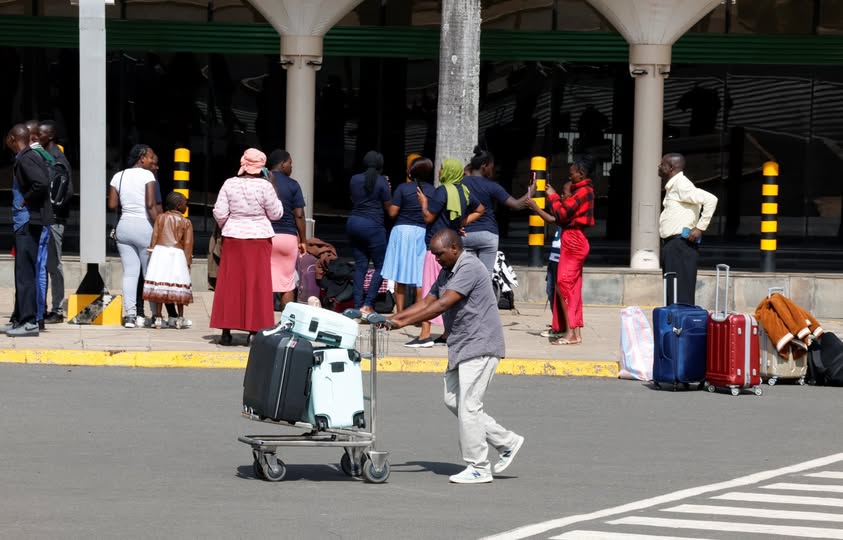
Kenya’s aviation sector remains severely disrupted as industrial action by the Kenya Aviation Workers Union (KAWU) enters its second day, leaving thousands of passengers stranded at airports in Kenya and abroad and causing widespread flight delays, cancellations and rescheduling.
The disruption has been particularly severe at Jomo Kenyatta International Airport (JKIA), Kenya’s main international aviation hub, where some passengers have reported waiting for more than six hours as airlines struggle to operate normally.
Several airlines, including Kenya’s national carrier, have confirmed disruptions and advised passengers to check their flight status before travelling to the airport.
The strike has also affected travellers outside Kenya whose flights were scheduled to arrive in Nairobi. Some passengers have reported being stranded overseas after flights to JKIA were cancelled.
One traveller said he had been stuck for almost three days after his original flight was cancelled. He subsequently purchased another ticket with Turkish Airlines, only for that flight to be cancelled as well. He said his luggage had also been missing since Saturday and estimated that he had spent nearly $2,300 on hotels, food and rebooking costs without receiving refunds.
Other passengers have described spending hours at the airport without adequate information, food or water as they wait for clarity on their flights.
Disruption reaches beyond passengers
Kenyan travellers and businesses operating internationally are also feeling the impact. Former Principal Secretary Irungu Nyakera said he was stranded in Saudi Arabia after his flight to Nairobi was cancelled, warning that the disruption could have wider consequences for Kenya’s economy.
The prolonged disruption threatens to affect tourism, cargo movement, business travel and international trade, with JKIA serving as a major gateway for East Africa.
Airlines have consequently urged passengers without confirmed flights to avoid travelling to the airport, as the disruption has created a growing backlog of travellers.
The Kenya Airports Authority (KAA) has issued a similar advisory, asking passengers to contact their respective airlines and confirm flight status before travelling to JKIA.
JKIA at the centre of the disruption
The situation at JKIA is particularly significant because the airport is one of East Africa’s most important aviation and logistics hubs, connecting Kenya with destinations across Africa, Europe, the Middle East and Asia.
Extended disruption could therefore have implications beyond Kenya, particularly for regional passengers using Nairobi as a transit point and businesses relying on the airport for time-sensitive cargo.
With the industrial action now in its second day and no immediate resolution in sight, pressure is mounting on authorities and aviation stakeholders to restore normal operations and prevent further losses to passengers, airlines and the wider economy.
For travellers, authorities continue to recommend confirming flights directly with airlines before going to JKIA, as schedules remain subject to change while the disruption continues.