A catastrophic glacier collapse in the Himalayas has put the world’s rapidly changing mountain environments back in the spotlight, after a massive ice-and-rock collapse triggered devastating floods along the Nepal–Tibet border.
The disaster, which struck on August 26, has killed hundreds of people and left more than 1,000 missing across Nepal and China’s Tibet region, according to the latest reports. The collapse sent huge quantities of ice, rock and debris into mountain valleys, triggering powerful floods and destroying homes, roads and bridges.
Scientists studying satellite imagery say the disaster began when part of a glacier and the underlying mountain slope collapsed at high altitude. The falling ice and rock entered a river system, creating a temporary blockage before the accumulated water and debris surged downstream.
The event is a dramatic reminder that glaciers are not simply frozen reservoirs of water. As mountain environments warm, changes in ice, snow, permafrost and surrounding rock can destabilise slopes and create new risks for communities living far below.
Scientists have cautioned that it is too early to attribute the Nepal disaster directly to climate change. However, researchers say warming is making high-altitude environments increasingly unstable, while glacier retreat and thawing permafrost can contribute to conditions that increase the likelihood of landslides, avalanches and glacial floods.
A global warning from the Himalayas
The Nepal disaster is unfolding in one of the world’s most important mountain regions.
The Hindu Kush Himalaya contains tens of thousands of glaciers and supplies water to major river systems across Asia, supporting hundreds of millions of people directly and billions more downstream.
But the region is warming rapidly. Scientists are increasingly concerned about a double-edged effect: in the short term, accelerated melting can increase water and flood risks, while in the longer term, continued ice loss threatens water availability and mountain ecosystems.
The Nepal disaster therefore offers a glimpse of one possible consequence of a changing cryosphere — the scientific term for the Earth’s frozen water.
But the story is not limited to Asia.
Africa has glaciers too
Africa’s remaining glaciers are found in three main mountain systems: Mount Kilimanjaro in Tanzania, Mount Kenya in Kenya and the Rwenzori Mountains on the Uganda–Democratic Republic of Congo border.
They are among the world’s most unusual glaciers because they exist close to the Equator.
Yet all three are retreating.
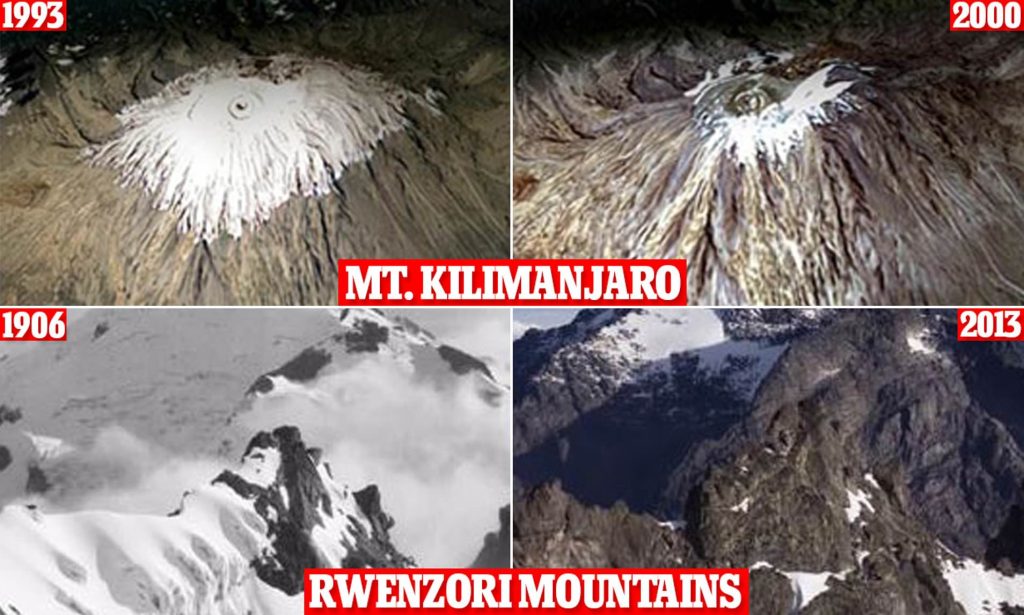
On Mount Kilimanjaro, Africa’s highest mountain, the ice fields have lost roughly 90 percent of their area since they were first mapped in 1912. The mountain still has ice at its summit, but the remaining glaciers are dramatically smaller than those seen by earlier generations.
The change is particularly striking because Kilimanjaro’s glaciers have become one of the world’s most recognisable symbols of African mountain landscapes.
The Rwenzori: ice on the Equator
The Rwenzori Mountains offer another extraordinary example.
Located along the Uganda–DRC border, the range rises above 5,000 metres and contains some of the continent’s remaining glaciers.
But the ice has been shrinking rapidly.
Researchers have documented dramatic changes in the Rwenzori’s glaciers over recent decades, with ice becoming fragmented and exposed rock increasingly appearing where glaciers once covered the landscape.
For Uganda and the wider region, the mountains are important not only for their glaciers but also as a major water catchment and ecosystem.
Mount Kenya is losing its ice
Kenya’s Mount Kenya, Africa’s second-highest mountain, is also experiencing rapid glacier retreat.
Its remaining glaciers are now only remnants of a much larger ice system that existed in the past.
The disappearance of Mount Kenya’s glaciers would represent the loss of an important scientific record of the continent’s climate history, as well as a dramatic transformation of one of East Africa’s most iconic landscapes.
And then there is Karisimbi
Rwanda’s Mount Karisimbi, standing at 4,507 metres in the Virunga Mountains, adds another dimension to Africa’s high-altitude story.
Karisimbi is not home to a permanent glacier. However, its summit can experience extremely cold conditions, including temporary snow, sleet and hail.
Its white-capped summit has long been part of the mountain’s identity, showing that even around the Equator, high-altitude environments can produce conditions associated with much colder parts of the world.
Karisimbi therefore provides an important distinction in the African story: not every African mountain with snow or ice has a glacier.
What happens when Africa’s glaciers disappear?
The loss of Africa’s glaciers will not mean that major rivers across the continent suddenly stop flowing.
Glacial melt accounts for only a relatively small proportion of water flowing from the major East African mountain systems.
But the disappearance of the ice will have consequences for ecosystems, tourism, scientific research, landscapes and climate monitoring.
Glaciers also function as natural archives. Layers of ice contain information about atmospheric conditions and climate patterns from the past. Once the ice disappears, much of that record can be lost.
There is also a cultural and tourism dimension.
For generations, climbers approaching Kilimanjaro, Mount Kenya and the Rwenzori have encountered landscapes shaped by snow and ice. Future generations could climb the same mountains and see a fundamentally different summit environment.
A future without African glaciers?
The outlook is increasingly stark.
The IPCC has reported that African glaciers have undergone substantial reductions and cited projections that glaciers on Mount Kenya and the Rwenzori Mountains could disappear within the coming decades, with Kilimanjaro also facing eventual loss under continued warming.
UNESCO has similarly warned that glaciers in African World Heritage sites are very likely to disappear by around 2050 under current projections.
The exact timing remains uncertain because glacier behaviour depends on temperature, precipitation, cloud cover, atmospheric moisture and local mountain conditions.
But the direction is clear.
Nepal’s warning for Africa
The tragedy unfolding in the Himalayas should not be interpreted to mean that a similar catastrophe is inevitable in Africa.
The mountains are different, the glaciers are different and the hazards are different.
What the Nepal disaster demonstrates, however, is that changes in mountain ice can have consequences far beyond the ice itself.
A glacier can retreat quietly over decades. But under the right conditions, the collapse of ice, rock and water can happen suddenly, transforming a remote mountain environment into a disaster zone hundreds of kilometres downstream.
For Africa, the lesson is one of preparedness.
The continent’s remaining glaciers should be closely monitored, mountain ecosystems protected, scientific research strengthened and early-warning systems improved in vulnerable high-altitude areas.
The ice on Kilimanjaro, Mount Kenya and the Rwenzori may occupy only a tiny part of Africa’s landscape.
But its disappearance is part of a much larger global story.
From the Himalayas to East Africa, the world’s high mountains are changing and the future of their ice is becoming one of the clearest indicators of how a warming planet is reshaping the places where nature once seemed permanent.