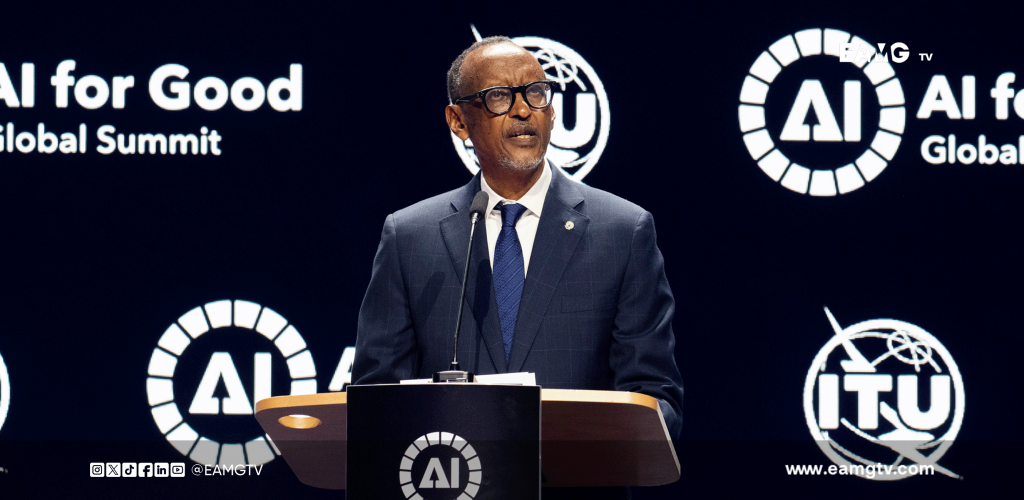
President Paul Kagame has called for Africa to play a leading role in shaping the future of artificial intelligence (AI), urging governments, businesses, and international organizations to work together to ensure the technology benefits all of humanity.
Speaking at the AI for Good Summit in Geneva after the launch of the AI for Good Global Commission, which he co-chairs, Kagame said AI has the potential to transform lives, strengthen economies, and accelerate development if deployed responsibly and inclusively.
“We have gathered here because of our strong commitment to make artificial intelligence safer and more accessible,” Kagame said. “Artificial intelligence has the power to transform lives and strengthen economies.”
He praised the International Telecommunication Union (ITU) for promoting AI as a tool for global equity while warning that geopolitical rivalries risk turning technological innovation into a competition rather than a solution to shared global challenges.
“The challenges ahead of us are evident. Geopolitical rivalries have turned technology into a competition. This diverts attention from how AI tools can speed up development,” he said.
Kagame argued that Africa is uniquely positioned to become a major player in the global digital economy, pointing to the continent’s rapidly growing and youthful workforce.
“By 2050, our continent will have the largest and fastest-growing workforce in the world,” he said. “There are many success stories about what our young people are doing with artificial intelligence. We have to invest in them. It will be a win-win for everyone.”
The Rwandan leader emphasized that Africa should no longer be viewed merely as a consumer of technologies developed elsewhere.
“In Africa, we are no longer satisfied to be passive consumers of technology. We want to build and deploy it at scale,” he said.
Kagame outlined three priorities for unlocking AI’s potential: expanding digital infrastructure, investing in skills development, and building transparent governance frameworks that inspire public trust.
He said access to computing power, reliable internet connectivity, and energy must improve through stronger collaboration between governments and the private sector, while education systems should continuously adapt to prepare young people for an AI-driven economy.
On governance, Kagame stressed that accountability must remain central to AI development, arguing that regulatory frameworks should promote trust and transparency rather than deepen global inequalities.
Highlighting Rwanda’s own experience, he pointed to the country’s Health Intelligence Centre, which uses artificial intelligence and real-time health data to predict disease outbreaks and support evidence-based policymaking.
He also noted that the Smart Africa Alliance, which he chairs, established the Africa AI Council last year as part of broader efforts to strengthen the continent’s digital transformation.
Kagame concluded by urging governments and industry leaders to act with urgency as AI continues to evolve.
“To invest in artificial intelligence is to secure our future and that of the generations coming after us,” he said. “We must be intentional about designing, funding and governing AI so that it can reach its full potential.”
His remarks come as global leaders increasingly debate how artificial intelligence should be governed, with growing calls to ensure developing countries play an active role in shaping the technologies that will define the future of the global economy.