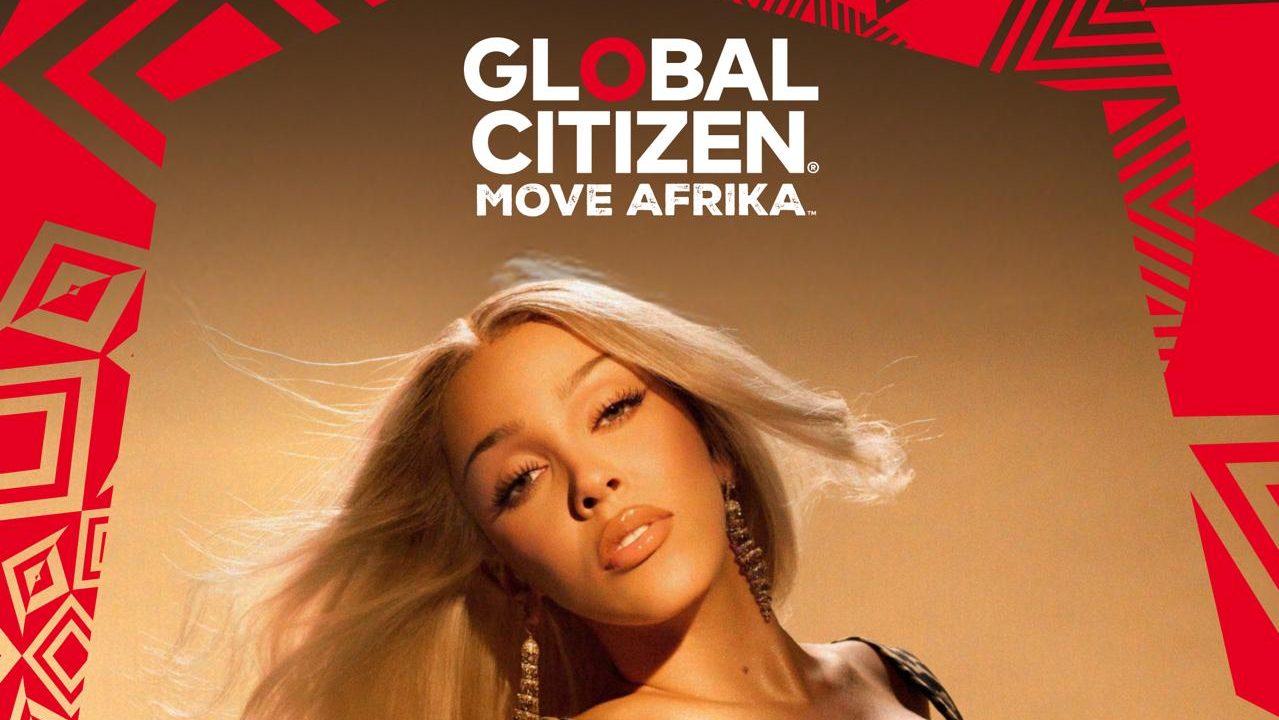
There are concerts, and then there are moments that feel like markers. Doja Cat’s arrival in Kigali — her first performance on African soil — belongs firmly to the latter.
On Tuesday night, March 17th, the Grammy-winning artist headlines the Move Afrika concert at BK Arena, stepping onto a stage that is increasingly becoming a crossroads between global pop culture and Africa’s fast-evolving creative economy. The energy in the room and beyond has been phenomenal. Literally all of Africa is represented at the BKArena. However, for the discerning and perhaps slightly older viewer, does this show represent a shift in the way global stars view performing in Africa?
The artist behind the moment
Born Amala Ratna Zandile Dlamini in Los Angeles, with South African roots, Doja Cat’s career did not begin with arenas or global tours. It began online — uploading tracks to SoundCloud as a teenager, experimenting across genres long before the industry could define her.
Her breakout moment came in 2018 with Mooo!, a deliberately absurd, internet-native track that went viral and introduced her as an artist unafraid to blur the line between satire and serious musicality. What followed was less accidental.
With Hot Pink (2019), she crossed into the mainstream. Say So — buoyed by a remix featuring Nicki Minaj — became her first Billboard Hot 100 No. 1, marking a turning point not just commercially, but culturally. She wasn’t simply making hits; she was shaping sound.
Then came Planet Her (2021), a project that confirmed her as one of the most versatile artists of her generation — moving between rap, pop, R&B, and electronic textures with ease.
Recognition followed. A Grammy Award for Kiss Me More (with SZA), multiple Billboard Music Awards, American Music Awards, MTV VMAs — the industry, in its many forms, has repeatedly validated what audiences already knew: Doja Cat is not easily boxed.
Kigali, centre stage
At BK Arena, that fluidity translated into performance.
Her set moves seamlessly — from high-tempo rap verses to melodic hooks — held together by tight choreography, striking visuals, and a stage presence that is equal parts control and chaos. It is a balance she has refined over time: knowing when to lean into spectacle, and when to let the music carry.
The audience meets her there as well. Abanyakigali or Kigalians and their visitors are not passive. They sing, dance, record, react — fully present in a moment that at once feels both global and distinctly local.
Move Afrika, the platform behind the concert, is designed with that intersection in mind. Spearheaded by Global Citizen, the initiative aims to build long-term touring infrastructure across the continent — investing in local crews, production standards, and creative industries that extend beyond a single night’s performance. In Kigali, that vision feels tangible.
More than a tour stop
There is a tendency, in global touring circuits, to treat Africa as an afterthought — an optional addition rather than a central market. That dynamic is changing, slowly but visibly.
Doja Cat’s presence in Kigali is part of that shift.
It matters that an artist of her scale — one who has headlined major festivals and dominated streaming platforms — is performing here, not as a novelty, but as part of a structured, intentional tour. It matters that the production meets international standards. It matters that the audience shows up in full force.
And it matters, too, that the moment resonates beyond the arena.
For many in attendance, this is more than access to a global star. It was proximity to an industry that often feels geographically distant. It was proof — visible, audible — that the gap is narrowing.
Style, spectacle, and the Doja Cat effect
If the music anchors the night, the aesthetics elevate it.
Doja Cat has built a reputation on visual unpredictability — an artist as comfortable in avant-garde fashion as she is in viral internet culture. In Kigali, she is delivering on that expectation, pairing bold, futuristic looks with a performance that leans into theatricality without losing musical precision.
And the crowd laps it up – all of it.
Across the arena, fashion statements have become part of the experience: streetwear meets high concept, Afrocentric expression communes with global trends. It was not curated, but it was coherent — a reflection of a generation that consumes culture globally but expresses it locally.
The longer view
Strip away the lights, the setlist, the immediate excitement, and what remains is a question of trajectory.
Where does this lead?
If Move Afrika succeeds in its ambition — building sustainable touring infrastructure, nurturing local talent, embedding Africa more firmly into global entertainment circuits — then nights like this will become less exceptional, more expected.
For now, they remain markers.
Doja Cat came to Kigali and has delivered a performance that meets her global standard. But the more compelling story is what the city, the audience, and the platform signaled in return.
Africa is not waiting to be included.
It is building its own stage — and increasingly, the world is stepping onto it.