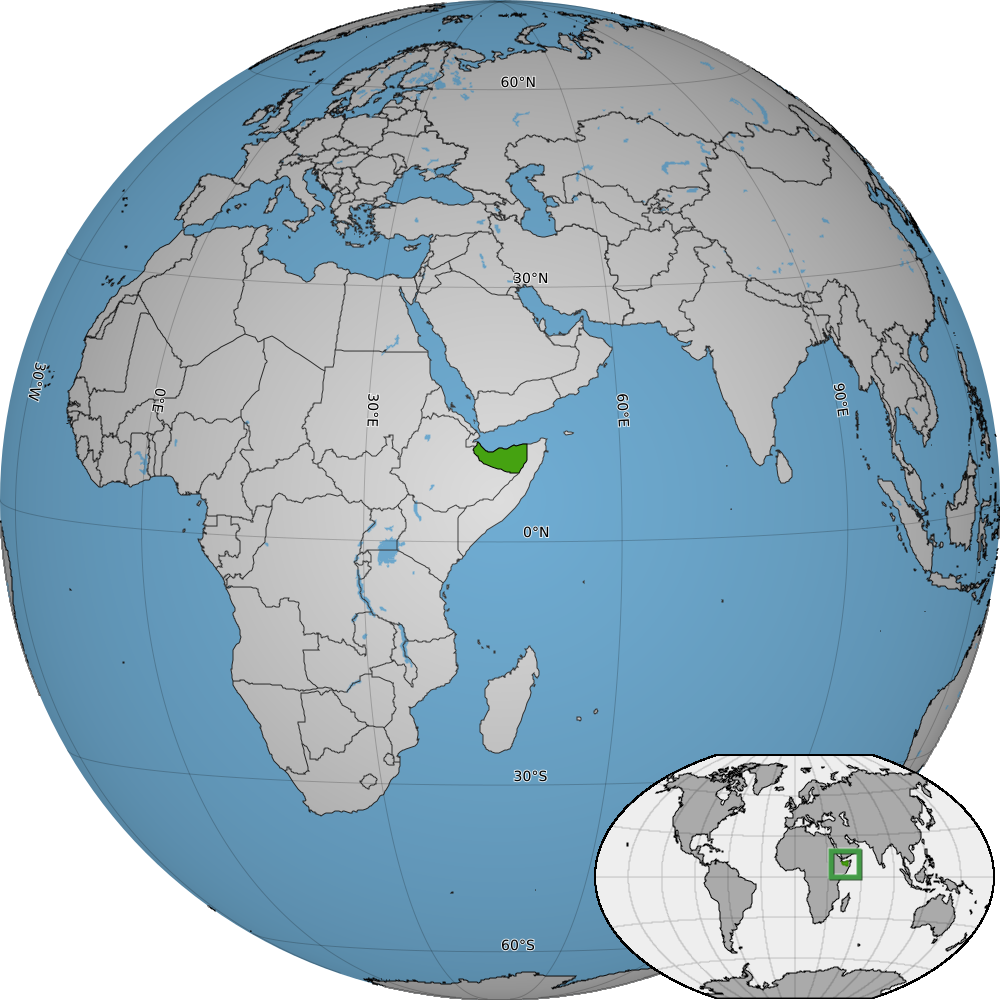
The question of what it would mean if Israel were to recognize Somaliland is not an exercise in conjecture about future intentions. It is a question about institutional consequences within the existing international system: how recognition operates in international law, how African multilateral norms function, how Middle Eastern–Horn of Africa relations are structured, and how state behavior has historically responded to unilateral recognition acts. This analysis therefore focuses on documented frameworks, precedents, and structural realities, rather than predictions.
Somaliland declared independence from Somalia in 1991 following the collapse of the Siad Barre regime. Since then, it has maintained effective territorial control, built domestic governing institutions, conducted multiple elections, and sustained relative internal stability. These facts are widely acknowledged, including by international observers. Yet Somaliland has not been formally recognized as a sovereign state by any United Nations member. Somalia, for its part, continues to assert sovereignty over the territory as part of its internationally recognized borders.
Recognition by Israel—were it to occur—would therefore intersect with several non-negotiable geopolitical disciplines: international law, African regional order, Middle East diplomacy, Red Sea security, and the politics of recognition itself.
1. Recognition in International Law: Declaratory vs. Constitutive Reality
International law distinguishes between statehood and recognition. Under the Montevideo Convention criteria—permanent population, defined territory, effective government, and capacity to enter relations—Somaliland demonstrably satisfies the functional requirements of statehood. Recognition, however, remains a political act, not a legal one.
Israel recognizing Somaliland would not, in itself, alter Somaliland’s legal status within the United Nations system. Membership in the UN requires approval by the Security Council and the General Assembly. Israel is not a permanent member of the Security Council, and unilateral recognition does not compel multilateral acceptance.
What recognition would do—based on established practice—is normalize bilateral relations: allowing diplomatic exchange, formal agreements, and state-to-state cooperation. This mirrors Israel’s recognition of South Sudan in 2011 after that state achieved internationally sanctioned independence, though the Somaliland case differs critically because Somalia has not consented to secession.
The discipline here is clear: recognition creates bilateral legality, not international legitimacy. Israel’s act would be lawful within its sovereign discretion but insufficient to internationalize Somaliland’s status.
African Union Norms and the Principle of Territorial Integrity
The African Union has consistently upheld the principle of territorial integrity inherited at independence, a doctrine dating back to the Organization of African Unity. This norm was developed to prevent endless border disputes in post-colonial Africa.
Somaliland represents a challenge to this doctrine because it corresponds closely to the borders of the former British Somaliland protectorate, which briefly existed as a recognized state in 1960 before uniting with Italian Somaliland. This historical fact has been cited in AU fact-finding missions, including a 2005 AU report acknowledging Somaliland’s unique case.
However, acknowledgment has not translated into recognition. The AU has avoided setting a precedent that could embolden separatist movements elsewhere on the continent. Israel recognizing Somaliland would therefore place Israel outside the prevailing African consensus, without altering that consensus itself.
This matters because African multilateral diplomacy remains coordinated. States that deviate from AU norms often do so quietly and bilaterally; public recognition by a non-African state would be viewed institutionally as external disruption, not continental validation.
Somalia–Israel Relations and Diplomatic Fallout
Somalia does not maintain formal diplomatic relations with Israel and has historically aligned itself with Arab League positions on the Palestinian question. Somalia’s sovereignty claim over Somaliland is supported by its international recognition, including by the UN and AU.
Recognition of Somaliland by Israel would therefore constitute a direct diplomatic rupture with Somalia. Under international diplomatic practice, Somalia would have grounds to protest, downgrade engagement, or lobby multilateral forums against such recognition. None of these responses would be speculative; they are standard instruments used by states defending territorial claims.
This dynamic would not be unique. Comparable diplomatic protests followed recognitions in other contested territories globally. The discipline here is that recognition of a secessionist entity necessarily entails a deterioration of relations with the parent state, regardless of broader strategic considerations.
Middle East–Horn of Africa Relations and Red Sea Security
Israel’s foreign policy toward the Horn of Africa has historically been shaped by Red Sea security, maritime access, and counter-hostile influence. The Red Sea corridor connects the Indian Ocean to the Mediterranean and remains one of the world’s most strategically sensitive maritime routes.
Somaliland’s coastline along the Gulf of Aden gives it geographic relevance to Red Sea security architecture. Israel already engages diplomatically and economically with several Red Sea–adjacent states, including Egypt, Jordan, and Ethiopia. Any formal relationship with Somaliland would be interpreted through this maritime-security lens.
However, it is critical to note that security cooperation does not require recognition. States routinely engage subnational authorities, de facto administrations, and regional governments without conferring sovereign status. Israel’s existing security relationships globally demonstrate that recognition is a political choice, not a security necessity.
Thus, the implication is institutional: recognition would signal political alignment, not merely pragmatic cooperation.
Arab League, Gulf States, and Diplomatic Signaling
Somaliland’s geopolitical environment is also shaped by the interests of Gulf states, several of which maintain commercial or logistical presence in the territory. These engagements have occurred without recognition and often in coordination with Somalia or under commercial frameworks.
Israel’s recognition would be read by members of the Arab League not as a neutral legal act, but as part of Israel’s broader diplomatic posture in the Middle East and Red Sea region. This would matter particularly given Israel’s recent normalization agreements under the Abraham Accords, which reshaped relations between Israel and several Arab states.
While those accords have expanded Israel’s regional diplomatic space, they have not erased Arab League positions on territorial integrity in non-member states. Recognition of Somaliland would therefore complicate Israel’s diplomatic balancing act with Arab and Muslim-majority partners in Africa and the Middle East.
Precedent and the Politics of Selective Recognition
States are acutely sensitive to precedent. Recognition of Somaliland by Israel would be interpreted globally as a selective recognition based on strategic interest rather than multilateral process. This perception matters because it influences how other states justify or resist recognition in their own contested regions.
The international system functions less on written law than on behavioral consistency. States that recognize breakaway regions in one context often resist similar claims elsewhere. Israel itself has navigated this complexity in other territorial and recognition disputes.
The disciplined conclusion here is not about moral judgment but about systemic consequence: selective recognition weakens universalist claims about international order, even when grounded in pragmatic considerations.
Somaliland’s Internal Governance and External Constraints
Recognition by any single state does not remove Somaliland’s structural constraints: lack of access to international financial institutions, inability to sign multilateral treaties, and exclusion from formal development finance mechanisms. These constraints are products of collective recognition, not bilateral ties.
Israel’s recognition would therefore be symbolically significant but materially limited in transforming Somaliland’s international position. This distinction is crucial to avoid overstating the impact of recognition as a singular event.
Conclusion: Recognition as a Political Signal, Not a Structural Shift
Analyzed through the disciplines of international law, African regional norms, diplomatic practice, and security architecture, the implications of Israel recognizing Somaliland are clear and bounded.
Such recognition would:
- Establish lawful bilateral relations without conferring international legitimacy.
- Place Israel outside the African Union’s prevailing consensus on territorial integrity.
- Trigger predictable diplomatic opposition from Somalia.
- Be interpreted through Red Sea security and Middle East geopolitical lenses.
- Carry symbolic weight disproportionate to its material effects.
Recognition, in this case, would function primarily as a political signal, not as a transformation of Somaliland’s legal or institutional status in the international system.
Understanding these implications requires resisting speculation and instead grounding analysis in the structures that govern state behavior. Those structures suggest continuity, not rupture: recognition would be consequential, but not decisive.