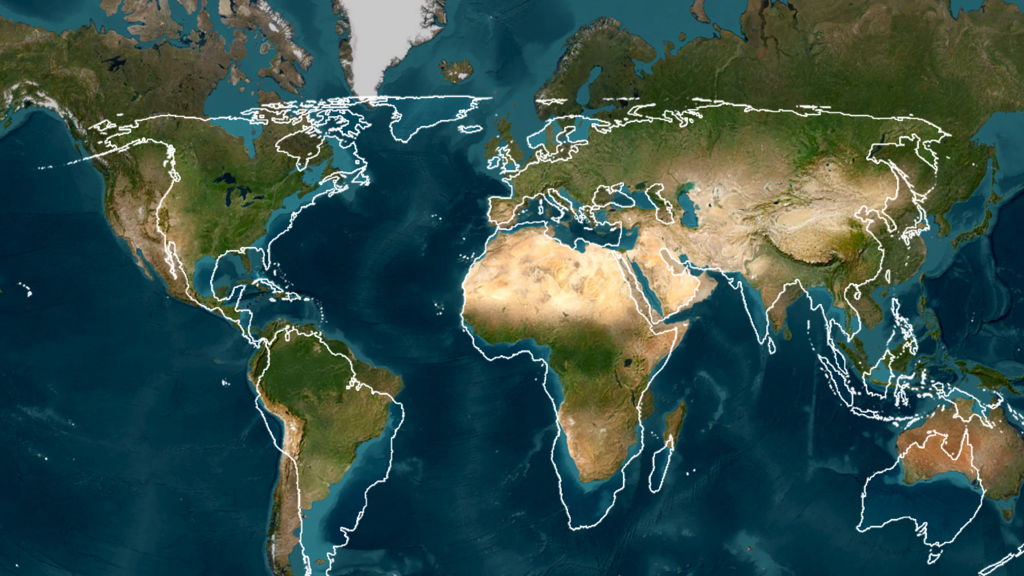
The United Nations General Assembly has backed a move to promote world maps that more accurately represent the size of continents, particularly Africa, in a vote led by Togo and supported by the African Union.
The “Correct the Map” resolution was adopted on Friday with 164 countries voting in favour, while the United States was the only country to vote against. Six countries — Serbia, Estonia, Georgia, Lithuania, Moldova and Ukraine — abstained.
The resolution encourages governments, international organisations, educational institutions and other bodies to promote the use of cartographic projections that better represent the relative size of the world’s land masses. It does not legally prohibit the use of the Mercator projection or make the Equal Earth map mandatory.
The initiative is centred on replacing the widespread use of the Mercator projection in contexts where the relative size of continents is important with alternatives such as the Equal Earth projection, developed in 2018.
The Mercator projection was created by Flemish cartographer Gerardus Mercator in 1569, primarily for navigation. Its design preserves directions and angles useful for maritime travel but significantly distorts the apparent size of land masses as they move farther from the equator.
As a result, Greenland can appear comparable in size to Africa on a standard Mercator map, despite Africa being approximately 14 times larger in actual land area.
The Equal Earth projection, by contrast, is designed as an equal-area map, allowing the relative size of continents to be represented more accurately while retaining recognisable shapes.
The campaign has been driven by African governments and advocacy groups seeking to address what they describe as longstanding distortions in the way Africa is visually represented in classrooms, media, digital platforms and official materials.
Togo’s Foreign Minister Robert Dussey, who led the initiative, argued that maps influence how people understand the world.
“A fair world begins with a fair map,” Dussey told Reuters ahead of the vote. He also argued at the United Nations that cartographic representations can shape perceptions of the relative importance and position of different regions.
Togo has said it intends to update its own school geography materials by the end of 2026 and plans to work with African Union members, other governments and technology companies to encourage wider adoption of more accurate projections.
France also supported the initiative. Foreign Minister Jean-Noël Barrot said changing a map would not change the world but argued that correcting a representation that distorts it was an important step toward accuracy.
The United States opposed the resolution, describing it as an ideological initiative and arguing that the General Assembly should focus on more pressing international challenges.
The US representative said the resolution diverted attention from issues involving international peace, prosperity and relations, and criticised the debate over 16th-century map projections and their connection to concepts such as “cognitive justice.”
Some countries also raised concerns about the proposed Equal Earth projection for reasons unrelated to Africa’s size. Ukraine, which abstained, said it had concerns about how Ukrainian territory temporarily occupied by Russia is represented on the projection.
The debate does not mean the Mercator projection will disappear. Its ability to preserve compass directions continues to make it useful for navigation, while different map projections remain appropriate for different purposes.
The UN vote instead represents a push toward using maps that provide a more accurate representation of continental area in education, public information and other settings where comparing the actual size of regions is important.
For African countries and campaigners behind the initiative, however, the vote carries a broader significance: they argue that correcting geographical distortions can contribute to a more accurate understanding of Africa’s physical scale and its place in the global community.